
NERSA's 26 November 2026 Decision on Eskom's 8.83% FY2028 Tariff Structure Is Now the PPA Tariff-Floor Wildcard Every C&I Solar and BESS Buyer Must Reprice Before Locking In Any Long-Tenor Supply Agreement: What a Contested Public Hearing, a Phased Generation Capacity Charge Stepping to 100% of RTP Rand-Value, and a Post-High-Court MYPD6 Redetermination Mean for Behind-the-Meter Displacement Economics, Wheeling Savings Margins, and BESS Payback Assumptions in Q1 2027
NERSA's 26 November 2026 decision on Eskom's FY2028 tariff structure — including a phased Generation Capacity Charge stepping toward 100% of RTP rand-value — is the PPA tariff-floor wildcard every C&I solar and BESS buyer must reprice before locking in any long-tenor supply agreement ahead of Q1 2027.
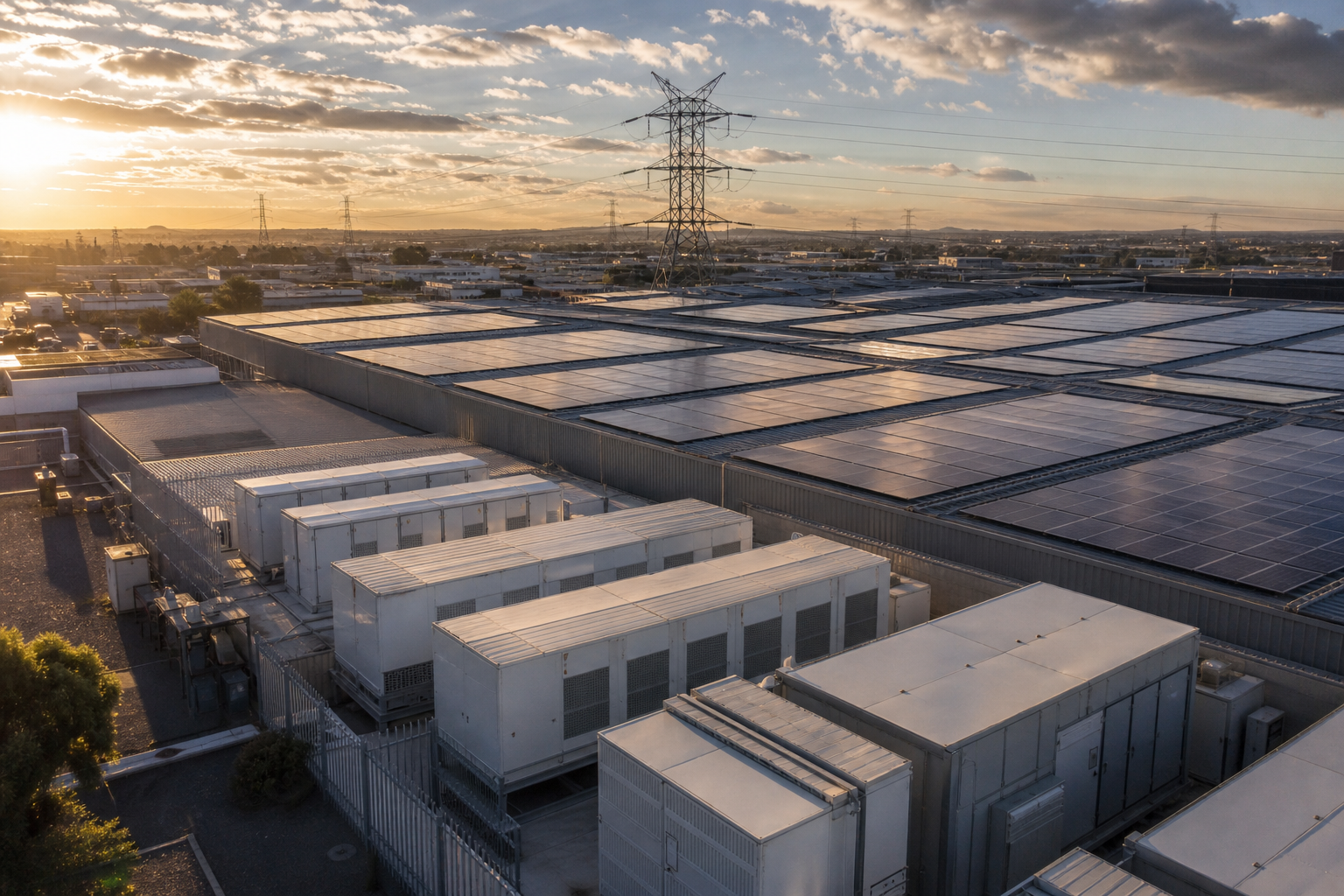
The Clock Is Running: Why NERSA's 26 November 2026 Decision Is the Most Important Date on Every C&I Energy Buyer's Calendar
In exactly thirteen days, the National Energy Regulator of South Africa (NERSA) will hand down the decision that determines how Eskom applies its 8.83% average tariff increase from 1 April 2027. For commercial property owners, CFOs, and operations directors currently negotiating or renewing solar Power Purchase Agreements (PPAs) and Battery Energy Storage System (BESS) contracts, this is not a regulatory footnote — it is the single biggest variable in your Q1 2027 energy cost model, and it must be resolved before you lock in any long-tenor supply agreement.
This is your practical buyer's guide to what is at stake, what the decision can and cannot change, and the five repricing actions you must complete before the ink dries on any new contract.
The Backstory: How an R54.7 Billion Error Created the 8.83% Path
When NERSA approved Eskom's Multi-Year Price Determination 6 (MYPD6) application in January 2025, it set tariff increases for 2026/2027 at just 5.36% and for 2027/2028 at 6.19%. Eskom quickly challenged the decision, arguing that NERSA had made material errors in calculating its Regulatory Asset Base, particularly for its generation business. The court ordered NERSA to redo its determination after a public consultation process, which it completed on 7 February 2026.
The regulator conducted a component-by-component recalculation of Eskom's Generation Regulatory Asset Base and settled on R54.7 billion in additional allowable revenue, to be phased in over three years: R12 billion in 2026/2027, R23 billion in 2027/2028 and R19.7 billion in subsequent years. The result is the 8.76% increase now approved for 2026/2027 — up from the 5.36% originally envisaged — with a further 8.83% increase set for 2027/2028, up from 6.19%.
Critically, the balance of R19.721 billion will be recovered beyond the MYPD6 period — meaning the structural tariff escalation trajectory does not end at FY2028. Every PPA modelled on a static or near-static grid tariff baseline is therefore mispriced at inception.
What Happens on 26 November 2026 — and What It Cannot Change
Eskom filed its tariff application on 31 July 2026, and written comments closed on 2 October. NERSA's timetable has an internal subcommittee recommending a decision to the Energy Regulator, NERSA's governing council, on 3 November, a decision on 26 November and notice to Eskom on 3 December.
The public hearing on 8 October was deeply contested. A recent public hearing on Eskom's proposed electricity tariff increases spilled into a wider debate about survival, with struggling households and small-scale fishers warning that rising energy costs are threatening both basic needs and livelihoods. The concerns followed a virtual public hearing convened by NERSA, where political parties, civic organisations and community representatives pushed back against Eskom's proposed tariff increases. A civil society petition opposing Eskom's proposed 2027/28 electricity price increase surged to nearly 5,800 signatures ahead of the public hearing.
However, here is the critical structural point every commercial buyer must internalise: NERSA said its process could not reopen how much revenue Eskom was allowed to make; it could only test whether the utility's proposed price schedule would collect that money correctly and fairly. Public objections may influence how the 8.83% is distributed across tariff components — but the total revenue envelope is closed.
The Generation Capacity Charge: The Fixed-Cost Wildcard Inside the 8.83%
The most commercially significant dimension of NERSA's 26 November decision is not the headline percentage — it is how Eskom proposes to restructure tariff components within that headline. The national average may be 8.83%, but the way Eskom restructures the individual components making up an electricity account could leave some customers facing considerably larger increases in portions of their monthly bill.
The Generation Capacity Charge (GCC) is the central mechanism to watch. The GCC — a fixed, monthly levy on contracted grid capacity — was stepped up from 20% to 30% of its full rand-value benchmark as of April 2026. The charge unbundled energy costs, adding a Generation Capacity Charge component that was prescribed to be phased in at 20% in year one and 30% in years two and three, to lessen the impact on customers.
The decision on the table moves recovery onto fixed service charges, stepping to 100% of the Retail Tariff Plan rand-value — so a solar customer's avoided unit is worth less than the headline suggests. This is the tariff-floor wildcard: if the FY2028 ERTSA decision confirms further GCC phase-in toward 100% of its RTP rand-value, then every kilowatt-hour your rooftop solar displaces becomes proportionally less valuable as a grid-bill offset, while the fixed monthly charge you cannot solar-away becomes larger.
Unlike energy charges — which can be reduced by generating your own solar power and consuming less from the grid — the GCC is a capacity-based, fixed monthly charge. Low load-factor users are highly affected by the Generation Capacity Charge because it is a fixed charge that applies monthly regardless of how much electricity is actually used.
What This Means for Behind-the-Meter Displacement Economics
The practical implication for behind-the-meter solar buyers is stark. As fixed charges rise as a proportion of the total electricity bill, the displacement savings ratio of rooftop solar — the percentage of your grid bill that solar generation offsets — compresses. A 500 kW rooftop system that displaced 70% of a grid bill structured predominantly as energy charges may only displace 55–60% of a bill in which fixed GCC charges represent a materially higher share.
The MYPD6 RAB redetermination is not a once-off correction — it is a structural repricing of South Africa's electricity infrastructure that will compound through every future MYPD cycle. C&I buyers who delay transitioning to funded solar and BESS are not simply paying today's tariff: they are absorbing an escalating base that grows faster than inflation, faster than revenue, and faster than most business energy budgets can absorb.
The two-year compounding effect is significant: NERSA has pre-approved an 8.83% Eskom tariff hike for FY2028, on top of the 8.76% already live from April 2026 — a two-year compound increase of approximately 18.4%. Any PPA signed at a fixed or CPI-linked tariff today is immediately hedged against that compounding trajectory.
Wheeling Savings Margins: The GCC Exclusion Problem
For C&I buyers pursuing off-site wheeling PPAs — increasingly popular as landmark projects like Naos-1, South Africa's 300 MW solar, 660 MWh BESS wheeling project backed by Sasol and Air Liquide, which reached financial close in February 2026, located near Viljoenskroon in the Free State — the GCC creates a specific pricing trap that must be modelled explicitly.
The FY2027 tariff revision introduced a structural change C&I buyers must price into their models: the portion of the Generation Capacity Charge included in the energy charge is excluded from the energy credit provided under wheeling and net-billing. If the November 26 decision further increases the fixed GCC component, wheeling savings margins — the difference between your wheeled PPA tariff and the grid tariff you notionally avoid — will compress further. Buyers who signed wheeling PPAs in 2024 or early 2025, before this structural unbundling was understood, may find their actual savings materially below original projections.
Grid connection constraints and wheeling tariff uncertainty remain the two largest near-term barriers to accelerating the 2026–2031 deployment pipeline. The 26 November decision adds a third: GCC phase-in trajectory uncertainty for multi-year wheeling contracts.
BESS Payback Assumptions: Three Levers the November Decision Will Reset
For C&I projects requiring backup power, adding a lithium-ion BESS at ZAR 3,500–4,500/kWh installed cost extends payback to 5–7 years but eliminates diesel generator costs and provides full energy independence during outages. However, the November 26 decision reshapes BESS payback economics through three specific mechanisms:
- Demand charge arbitrage value: For sites with high Notified Maximum Demands, the demand charge reduction alone may now justify the BESS investment. If GCC steps toward 100% of RTP rand-value, peak-shaving via BESS becomes proportionally more valuable — potentially shortening payback by 12–18 months on high-NMD sites.
- Energy charge arbitrage compression: Conversely, if fixed charges rise as a share of total bill, the value of time-of-use BESS dispatch (charging off-peak, discharging at peak) compresses proportionally, as the energy rate differential narrows relative to the fixed cost component.
- Carbon cost compounding: South Africa's Carbon Tax Phase 2, live from 1 January 2026, has raised the headline rate to R308/tonne and introduced Scope 2 electricity emission considerations — creating a compounding hidden cost multiplier for grid-dependent C&I businesses. BESS displacing grid consumption also offsets this carbon cost liability.
Five Actions Commercial Property Owners Must Take Before 26 November
- Stress-test your PPA tariff floor against two GCC scenarios. Model your behind-the-meter displacement savings and wheeling credit calculations under a 30% GCC scenario (current) and a scenario in which the GCC steps to 50%+ of RTP rand-value. Any PPA that only pencils out under the lower scenario is a contract you should not sign until after 26 November.
- Confirm your wheeling corridor capacity before the decision lands. South Africa's installed solar capacity reached 9.76 GW in 2026 and is projected to grow to 16.88 GW by 2031, placing growing pressure on available transmission headroom. Confirm that your proposed wheeling corridor has confirmed capacity before committing to an off-site PPA.
- Reprice your carbon cost baseline. Solar PPAs that appeared to offer 8–10 year payback periods on a static grid tariff baseline typically reprice to 5–7 year effective payback periods once carbon cost escalation is embedded in the avoided cost stack. Your model must reflect the R308/tonne carbon tax rate already live from January 2026.
- Do not anchor BESS payback to load-shedding avoidance. As of 30 September 2026, South Africa has recorded over 476 consecutive days without load shedding since 16 May 2025. BESS payback models built primarily on diesel displacement or outage insurance are now mispriced. Reanchor your BESS case on demand charge reduction, TOU arbitrage, and carbon cost avoidance.
- Lock in component pricing before January 2027. China's full elimination of VAT export rebates on solar modules in April 2026 and the staged removal of battery rebates — zeroing out January 2027 — have structurally reset the capex floor for every South African C&I solar and BESS project. Equipment costs will rise in Q1 2027. If your project is decision-ready, procure before the Chinese VAT rebate removal on batteries takes full effect.
The Bottom Line for Q1 2027 Contracts
The 26 November 2026 NERSA decision will not change the total revenue Eskom collects — that was sealed by the High Court-ordered MYPD6 redetermination. What it will determine is the structural distribution of that revenue across fixed and variable tariff components, and that distribution is precisely what determines whether your PPA, wheeling arrangement, or BESS business case delivers the savings margin you modelled.
With an 8.83% increase confirmed for FY2028 and additional NERSA revenue recovery still to be loaded beyond the MYPD6 period, a PPA or solar lease signed today locks in a fixed or CPI-linked energy rate against a grid tariff that is structurally escalating above inflation. The hedge value is real — but only if the contract is sized, structured, and tariff-floored against the post-26-November reality, not against the pre-decision assumption.
Wait for the decision. Then act fast. NERSA notifies Eskom on 3 December, and the new tariff structure becomes live for all Eskom direct customers on 1 April 2027. Your Q1 2027 contract window is narrower than it looks.
Sources & References
- TechCentral — "Eskom tariffs to surge on 1 April as Nersa blunder hits home" (March 2026)
- Newcastillian — "Eskom Tariff Increase 2026 and 2027: NERSA Approves 8.76% and 8.83% Hikes" (February 2026)
- Newcastillian — "NERSA Opens 2027 Eskom Tariff Consultation" (September 2026)
- The Citizen — "Petition against Eskom's 8.83% tariff hike passes 5,700 signatures" (October 2026)
- IOL / The Star — "Eskom tariff hearing lays bare growing fears over cost of electricity" (October 2026)
- Rio Times Online — "Eskom Tariff Increase of 8.83% Draws Backlash at NERSA" (October 2026)
- Joburg ETC — "Nersa gazettes Eskom's proposed 8.83% electricity hike for 2027" (September 2026)
- MyBroadband — "Eskom gets more big electricity price increases" (February 2026)
- Decentral — "What the Eskom–NERSA settlement means for your power bill"
- Cape Times — "Nersa faces pressure over Eskom tariff error" (September 2025)
- SolarXgen — "Eskom 8.76% FY2027 Tariff: MYPD6 RAB Cost Trap for C&I"
- SolarXgen — "Eskom GCC Hike to 30%: C&I Cost Impact 2026"
- SolarXgen — "Naos 1 BESS Wheeling PPA Benchmark for C&I 2026"
- SolarXgen — "SA Load-Shedding Streak: Reprice Your Solar & BESS Now"
- SolarXgen — "Carbon Tax Phase 2: C&I Solar PPA Reprice Guide"
- eFinancialModels — "South Africa Solar: REIPPPP Returns on a 6.2 GW Base" (2026)
- NovaNews / Paarl Post — "Communities urge Nersa to reject Eskom tariff hikes at public hearings" (October 2026)