REIPPPP Bid Window 7's Zero Wind Awards Are a Grid-Capacity Warning for C&I Solar: What the Transmission Bottleneck Revealed by BW7 Means for Site Selection, Route Bankability, and PPA Tenor in 2026
REIPPPP Bid Window 7's complete failure to award a single megawatt of onshore wind — despite a 3.2 GW allocation — is the clearest signal yet that South Africa's transmission grid has become the binding constraint on C&I solar investment. Here's what CFOs and property managers must understand about site selection, wheeling risk, and PPA structuring in 2026.
The Signal in the Silence: Why Zero Wind Awards in BW7 Are the Most Important Data Point for C&I Solar in 2026
When South Africa's Department of Electricity and Energy (DEE) announced the REIPPPP Bid Window 7 (BW7) preferred bidders in December 2024, the headline number was impressive on paper: eight preferred bidders named for projects with a combined contracted capacity of 1,760 MW. But the more consequential story was what didn't get awarded. Onshore wind — originally allocated 3.2 GW of the 5 GW tender — failed to win any capacity, making it the second consecutive round in which solar was the sole winner. For CFOs and property managers evaluating commercial and industrial (C&I) solar investments in 2026, this isn't just an interesting policy footnote. It is a grid-capacity warning that demands a fundamental re-evaluation of site selection, route bankability, and PPA structuring.
What BW7 Was Supposed to Look Like
BW7 was announced in December 2023 and targeted 5,000 MW — with 3,200 MW allocated for wind and 1,800 MW for Solar PV. The intent was to rebalance South Africa's procurement mix after Bid Window 6 turned into an all-solar affair. Wind energy was back on the table for procurement after BW6 had become an all-solar affair. Yet the market told a different story before a single preferred bidder was named.
BW7 sought to procure 3,200 MW of wind and 1,800 MW of solar — but the submission outcome revealed an undersubscription for wind technology at only 1,692 MW, while solar PV was oversubscribed with a total of 8,526 MW of capacity submitted. The reason for wind's collapse was not a lack of developer appetite. It was the grid. No wind projects were awarded in REIPPPP Bid Window 6 — which may explain the low turnout of wind projects in BW7. In BW6, the Department had received onshore wind bid responses amounting to 4,116 MW, all located in the Eastern Cape and Western Cape supply areas — and Eskom confirmed during evaluation that no grid capacity was available.
The DEE's response to BW7's wind shortfall was pragmatic but revealing: the unused onshore wind capacity — approximately 2,270 MW — was reallocated to Solar PV, enabling additional capacity to be brought into procurement where it could be connected and delivered sooner. Solar won because solar could actually connect. That distinction is everything.
The Transmission Bottleneck: A Structural Crisis, Not a Temporary Snag
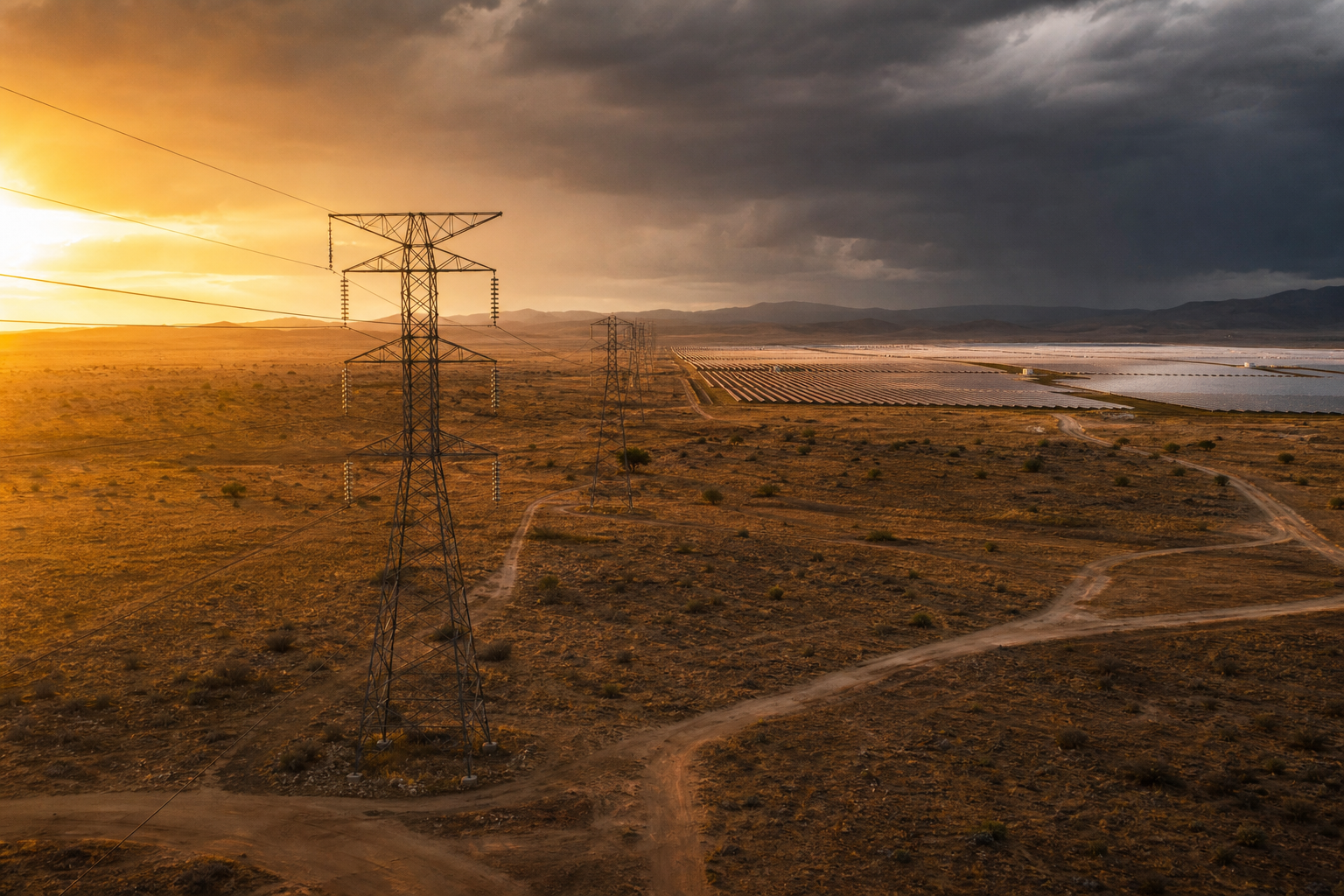
BW7's zero wind awards are a symptom of a deeper structural failure in South Africa's transmission infrastructure. Originally built to transmit power from centralised coal-fired power plants in specific regions, the grid is now overwhelmed by a surge of wind and solar projects seeking connection — with more than 80% of grid capacity in solar- and wind-resource-rich provinces like the Northern and Western Cape fully allocated.
Over the past two years, South Africa has seen a surge in private-sector interest in renewable energy, with more than 66 GW of projects registered in the pipeline — but many of these cannot be built or connected because the grid, especially in the Western, Northern, and Eastern Cape, is already saturated. In effect, South Africa has clean power ready to be delivered, but nowhere to put it.
The problem is compounded by the pace of infrastructure expansion. In South Africa, unconnected renewable-energy capacity in resource-rich regions underscores the bottleneck, as power generation is coming online faster than transmission infrastructure can be expanded. Meanwhile, skills shortages are limiting maintenance capacity, while capital constraints and long manufacturing lead times — often two to three years for critical equipment — are delaying upgrades.
This tension has spilled into the courts. A high court dispute between Mulilo and Eskom highlights intensifying competition for scarce grid capacity in South Africa's renewable energy sector, after 240 MW of previously allocated access was reassigned to rival projects. The case underscores how transmission constraints, regulatory uncertainty and allocation decisions are emerging as critical — and increasingly contested — factors shaping the country's energy transition. At issue is Eskom and the NTCSA's decision to cancel previously allocated grid access for a 240 MW privately procured solar PV project and reallocate that capacity to publicly procured BW7 projects. A high court granted an interim interdict in December 2025 in favour of Mulilo, restraining Eskom and the NTCSA from utilising the disputed capacity.
For C&I developers, the message is unambiguous: grid capacity is no longer a background assumption — it is the primary development risk.
Financial Implications for CFOs: Three Compounding Risks
1. Stranded Capital Risk from Grid-Constrained Sites
The delays in Bid Windows 6 and 7 of the REIPPPP have already illustrated the cost of inaction and are hurting investor confidence — developers spent time, resources, and capital preparing their bids, only to see fewer than anticipated preferred bidders because the national grid could not support the pipeline. For C&I projects, this same risk manifests when a rooftop or ground-mount installation is sized for export or wheeling, but the relevant substation is constrained. CFOs must now include grid capacity due diligence as a line item in pre-feasibility budgets, equivalent in importance to structural assessments and load profiling.
2. Route Bankability and Wheeling Agreement Fragility
Wheeling — the practice of transmitting privately generated power across the grid to a distant offtaker — is an increasingly attractive model for large C&I consumers. But grid congestion remains a major bottleneck, particularly in high-resource areas where projects are effectively stranded due to lack of connection capacity. Wheeling agreements that traverse congested corridors carry material curtailment risk. The Interim Grid Capacity Allocation Rules (IGCAR) process, which assesses the technical feasibility of a connection, is long, expensive, and inconsistent — adding timeline and cost uncertainty to what should be a predictable infrastructure decision. Any wheeling route that crosses the Cape corridors or relies on substations in the Eastern Cape wind zones should be stress-tested for capacity reallocation risk in the wake of the Mulilo litigation.
3. PPA Tenor and Lender Appetite
Winners of BW7 secured 20-year supply contracts — the gold standard for project finance. But the C&I market is moving in a different direction under grid pressure. Sosimple Energy has introduced a five-year solar power purchase agreement (PPA) for South Africa's commercial and industrial sector — reflecting how developers are hedging grid and regulatory uncertainty by shortening tenor. For CFOs, shorter PPAs reduce the locked-in savings horizon and can increase the effective blended cost of finance, since lenders require higher debt service coverage ratios on shorter-term revenue streams. The grid bottleneck is therefore not just an engineering problem: it is repricing risk across the entire C&I solar capital stack.
The Bright Spots: Where C&I Solar Still Works in 2026
The grid crisis has paradoxically accelerated innovation in project structures that bypass transmission constraints entirely. Lyra Energy — a joint venture between Scatec, Standard Bank, and Stanlib — builds utility-scale solar plants and sells output to multiple C&I customers through flexible, pooled PPAs. In February 2026, the venture signed offtake agreements with three top-tier commercial and industrial buyers covering most of the power from its 255 MW Thakadu solar plant in South Africa. Both aggregator and on-site models end up in the same place: contracted private power that bypasses the strained national grid.
BW7's awarded projects are also geographically instructive. Infinity Power Holding secured six projects, while Mulilo Renewable Project Developments and Scatec Solar Africa each won one — located in Mpumalanga, Limpopo, North West and the Free State, representing investment of R31.4-billion. These inland provinces — away from the congested Cape corridors — represent the frontier of grid-accessible capacity in South Africa's near-term pipeline.
At the policy level, there is cause for measured optimism. The Electricity Regulation Amendment (ERA) Act and the establishment of an independent National Transmission Company of South Africa (NTCSA) mark a structural shift towards a more competitive electricity market. A new partnership between the NTCSA and the IDC focuses on unlocking investment to expand and modernise South Africa's transmission infrastructure — given that limited transmission capacity has long been a critical bottleneck restricting new energy projects from connecting to the national grid.
Practical Recommendations: A BW7-Informed Checklist for C&I Decision-Makers
- Run a substation capacity audit before signing a lease or EPC contract. Request the relevant Generation Connection Capacity Assessment (GCCA) data for your proposed point of connection. If available capacity is below 20% of rated capacity, treat the project as high-risk until an IGCAR study confirms connection viability.
- Prioritise behind-the-meter and islanding-capable configurations. Projects that consume 80–100% of generation on-site sidestep grid allocation disputes entirely and carry no wheeling curtailment risk.
- Pair solar with BESS to improve bankability, not just load-shifting. Battery storage addresses lender concerns about intermittency and, in a post-SAWEM world, positions assets to monetise ancillary services as wholesale market rules mature.
- Scrutinise PPA tenor against your financing structure. A 5-year PPA may suit a balance-sheet-funded installation, but project-financed structures typically require 10–15 year minimum tenors. Mismatching these creates refinancing risk at the worst possible moment.
- Avoid wheeling routes that cross the Eastern Cape or Western Cape wind corridors without explicit, legally enforceable grid capacity reservations. The Mulilo litigation has demonstrated that even confirmed capacity can be reallocated.
- Monitor BW8 procurement geography. The DEE's shift of BW7 capacity toward inland solar provinces signals where future grid headroom will be created. C&I developers who pre-position in Free State, Limpopo and North West substations gain first-mover advantage as BW8 infrastructure investment flows.
Conclusion: The Grid Is Now Your Co-Developer
BW7's zero wind awards are not a story about wind falling out of favour. They are a story about a national grid that is structurally unable to accommodate South Africa's renewable energy ambitions at the pace the country needs. The real constraint holding the transition back is not generation, but transmission — without a modern, expanded national grid, even the most ambitious renewable build-out will struggle to reach homes, industries, and export-driven growth sectors.
For CFOs and property managers, the lesson is clear: in 2026, you are not just buying solar panels and an inverter. You are navigating a contested infrastructure landscape where grid access is the scarcest resource in the energy transition. The developers, advisors, and financiers who treat transmission capacity as the primary constraint — rather than an afterthought — will be the ones who close bankable deals. The rest will be waiting for a grid connection that may never come.
SolarXgen perspective: At SolarXgen, every C&I site assessment now includes a mandatory grid capacity layer — mapped against the latest GCCA data and cross-referenced against REIPPPP allocation decisions. BW7 taught the market that megawatts mean nothing without a wire to carry them. We design around that reality from day one.
Sources & References
- Green Building Africa — "The Complete Breakdown of South Africa's REIPPPP Bid Window 7 to Date" (July 2025)
- TaiyangNews — "Solar Wins South Africa's REIPPPP 7 Renewable Energy Auction" (December 2024)
- Engineering News — "Ministry Unpacks Latest Renewable Energy Preferred Bidder Awards" (January 2025)
- Green Building Africa — "BW7 Bidders List Released: Wind Undersubscribed, Solar Oversubscribed" (August 2024)
- Daily Maverick — "Renewable Energy Boom Meets Bottleneck as Grid Space Becomes the Real Battleground" (March 2026)
- Green Building Africa — "South Africa's Grid Bottleneck: Eskom, Legal Battles, and the Fight for Transmission Access" (March 2026)
- CNBC Africa — "South Africa's Energy Goals Depend on Grid Expansion" (July 2025)
- FurtherAfrica — "Why Renewables Can't Scale Without Fixing South Africa's Grid" (November 2025)
- Engineering News — "GRID UP: Tackling South Africa's Big Transmission Challenge" (February 2026)
- Solar Quarter — "South Africa Boosts Power Grid Expansion Through NTCSA and IDC Strategic Partnership" (May 2026)
- African Exponent — "Africa's Hidden Solar Boom: How C&I Platforms Are Quietly Consolidating a 40 GW Market" (May 2026)
- Energize — "Short-Term Solar PPA Launched for C&I Sector" (June 2025)
- Smart Procurement — "The Reality of the 2026 South African Energy Supply Chain" (May 2026)