Sibanye-Stillwater's 220 MW Etana Wheeling PPA Is Now the Mining-Sector Benchmark Every Multi-Site C&I Buyer Must Use to Reprice Portfolio Renewable Contracts: What a 10-Year Wind-Solar Mix Agreement, 600 GWh of Annual Wheeled Supply Across Gold and PGM Operations, and a Trader-Aggregator Delivery Model Mean for Multi-Site Load Aggregation, Wheeling Settlement Risk, and PPA Tenor Strategy in Q4 2026
Sibanye-Stillwater's 220 MW, 10-year wheeling PPA with Etana Energy — delivering 600 GWh annually across gold and PGM operations via a trader-aggregator model — is now the reference benchmark every multi-site C&I buyer must use to reprice portfolio renewable contracts in Q4 2026.
The Etana–Sibanye Deal in Brief
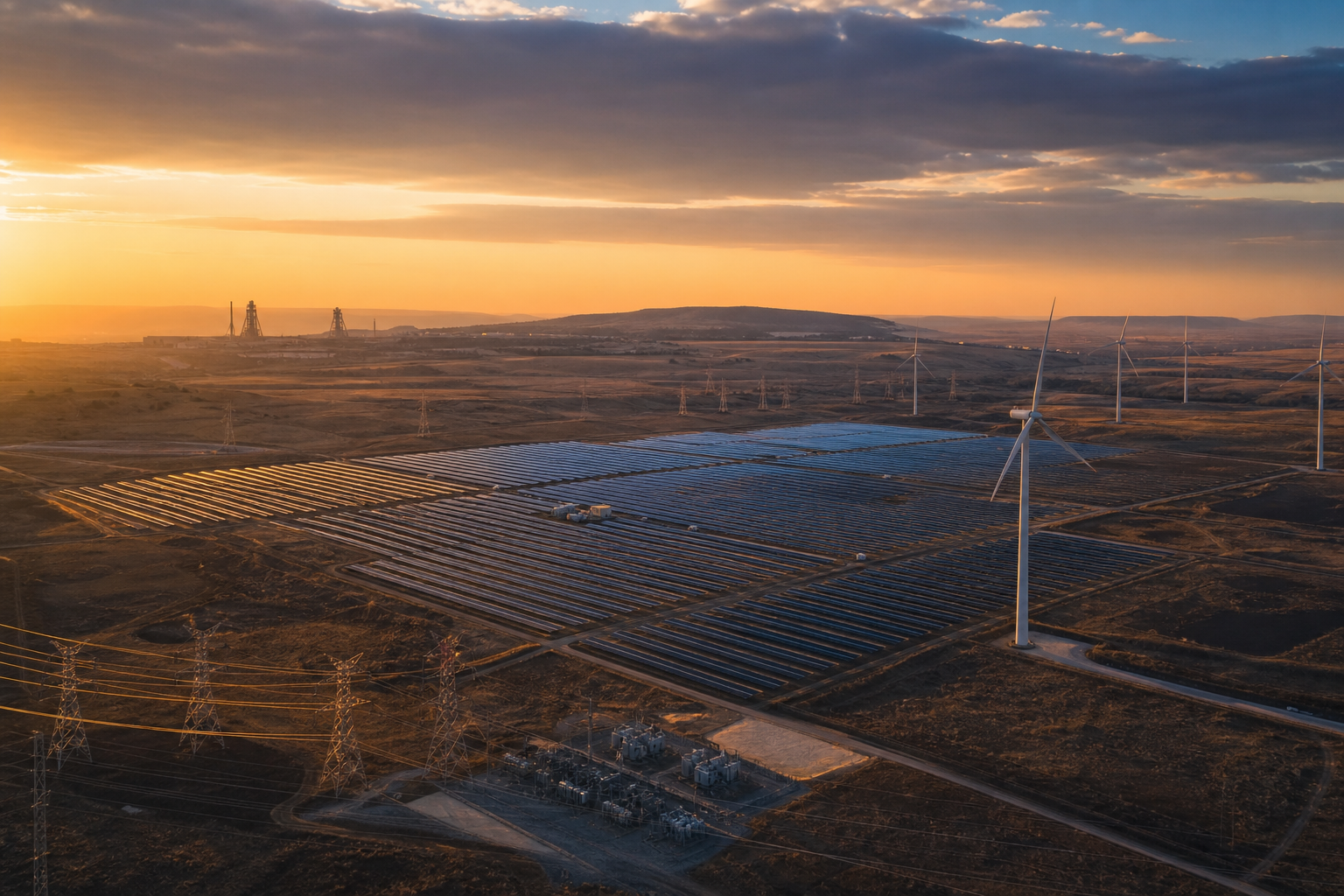
Sibanye-Stillwater has signed a market-leading, flexible power purchase agreement (PPA) for the procurement of wheeled renewable energy with Etana Energy. Under the 10-year agreement, Etana Energy — a licensed electricity trader — will supply 600 GWh per year of renewable electricity, equivalent to approximately 220 MW, from a diversified portfolio of solar and wind projects. Supply to Sibanye-Stillwater's mining operations is scheduled to commence in late 2027.
Electricity will be delivered through the national transmission network using a wheeling arrangement. This means power generated from renewable plants is fed into the national grid and then transmitted to selected mining sites — allowing the company to use clean energy without building separate power plants at each of its operations.
Portfolio Scale and Strategic Context
The additional 220 MW supply increases Sibanye-Stillwater's total renewable energy capacity under development from 407 MW at the end of 2025 to approximately 627 MW, delivering on the group's strategic target of 600 MW from renewable energy sources, enabling both decarbonisation and long-term electricity cost savings of 20–30% per annum relative to current Eskom utility rates.
This agreement is expected to reduce greenhouse gas emissions by approximately 648,000 tCO₂e. Cumulatively, from 2028, Sibanye-Stillwater's renewable energy portfolio is expected to generate 2.036 terawatt-hours (TWh) of clean energy annually, translating to a 2.198 mtCO₂e reduction in scope 2 emissions per year.
The Trader-Aggregator Model That Sets the Benchmark
The agreement was structured by Etana Energy to meet Sibanye-Stillwater's operational requirements, integrating seamlessly with its existing long-term bilateral PPAs and aligning with the life-of-mine profile of its South African operations. This is the key structural innovation: rather than a single point-to-point bilateral PPA, Etana acts as a licensed aggregator-trader, sourcing supply from a diversified wind-solar portfolio and absorbing generation mix risk on behalf of the off-taker.
This agreement represents the third long-term PPA concluded by Etana Energy with large mining companies, following agreements previously signed in 2024 with Tharisa Minerals and Petra Diamonds for wheeled renewable electricity supply. Etana Energy has now signed customer PPAs with more than 20 large electricity users.
Etana Energy is a NERSA-licensed electricity trader, majority black-owned, and backed by shareholders who are leading players in South Africa's renewable energy industry with over 2.5 GW of wind and solar already in operation. Its model is further strengthened through the support of leading local and global financial institutions — including Standard Bank, Norfund, British International Investment (BII), and GuarantCo — ensuring both financial credibility and execution capacity.
What This Means for Multi-Site C&I Buyers in Q4 2026
The Sibanye-Etana deal is now the clearest proof-of-concept that a trader-aggregator delivery model can serve geographically dispersed, high-load industrial portfolios at scale. For commercial property owners, multi-site manufacturers, and funded solar developers, four implications demand attention heading into Q4 2026:
- Load aggregation is now fundable at portfolio level. Wheeled energy — buying renewable electricity generated at one location and consumed at another, using the Eskom or municipal grid as the delivery mechanism — has moved decisively into the South African commercial and industrial mainstream. What was a niche structure in 2022 is now a standard procurement channel for large corporates. Multi-site C&I buyers should be aggregating their metered load across all sites and tendering as a single portfolio, not site-by-site.
- Ten-year tenor is now the reference standard. With local banks now comfortable with 20-year project tenors in rand, there is no reason for C&I off-takers to accept short-dated PPAs that leave them exposed to repricing risk. The Sibanye-Etana 10-year term should be viewed as the minimum benchmark — not the maximum ambition — for any portfolio PPA signed in Q4 2026.
- Wheeling settlement risk requires active management. Wheeling a solar project from the Northern Cape to a Gauteng offtaker adds ZAR 0.13–0.27/kWh in transmission and distribution charges, plus 5–8% energy losses, which must be factored into PPA pricing. NERSA is developing a standardised wheeling tariff framework, expected to be finalised in 2026–2027, which will significantly reduce transaction costs and unlock the private corporate PPA market. Buyers must ensure their PPA includes explicit provisions for wheeling tariff pass-through and loss reconciliation.
- BESS is the missing layer for wheeled multi-site portfolios. A wind-solar mix agreement like Sibanye-Etana's inherently carries intermittency exposure during evening peak windows. Behind-the-meter BESS deployed at each site converts a wheeled supply contract into a dispatchable energy stack — smoothing settlement mismatches and enabling demand-side flexibility that directly reduces Eskom Megaflex charges. For funded solar and BESS developers, the Etana model creates a clear pipeline: wherever a large industrial client has wheeled supply, on-site storage becomes the complementary layer that completes the energy solution.
The Broader Market Signal
So far in 2026, IPPs have accounted for 100% of new generation capacity and looking at the current build pipeline, the private sector demand will have a strong influence on what power projects get built going forward. A Power Futures Lab briefing note on South African IPPs shows a very large number of IPPs entering commercial operations in the first half of 2026 — 17 IPP projects reached commercial operations date (COD), adding 1,920 MW to the grid. This is South Africa's largest-ever half-year addition of commercial IPP operational capacity.
Private corporate PPAs, where a large industrial or mining company contracts directly with an IPP and wheels power across the Eskom grid, will grow from a small base to 2–3 GW by 2031 as wheeling regulations mature. The Sibanye-Etana deal — at 220 MW and 600 GWh per year — is the single largest wheeled mining-sector PPA yet announced in South Africa, and it will be the data point every energy manager, CFO, and renewable developer uses to reprice their next contract.
SolarXgen view: Any multi-site C&I portfolio that is still renewing Eskom Megaflex contracts without benchmarking against the Sibanye-Etana terms is leaving material cost savings on the table. The 20–30% annual saving versus Eskom tariffs is not a mining-sector anomaly — it is the new market rate for long-dated wheeled supply, and it is available to commercial property owners, manufacturers, and logistics operators at comparable scale.
Sources & References
- Africa Energy Portal – Etana Energy concludes a market-leading, flexible renewable energy PPA with Sibanye-Stillwater (February 2026)
- Mining Weekly – More renewable energy secured for Sibanye-Stillwater's South African mines (February 2026)
- African Mining Online – Sibanye-Stillwater secures an additional 220 MW PPA (February 2026)
- Ecofin Agency – Sibanye-Stillwater secures long-term renewable power for its mines (February 2026)
- Renewable Energy Africa – Tharisa mine signs power wheeling PPA with Etana Energy (2024)
- Etana Energy – Official website and resource centre
- ESI Africa – Private generation procurement for wheeling and energy trade (2026)
- Solink – Wheeled Energy Deals in South Africa: 2026 Market Update (July 2026)
- eFinancialModels – South Africa Solar Energy Investment Guide 2026–2031