South Africa's 10.12 GW Solar Saturation Threshold Is Now the Grid-Access Ceiling Every C&I Wheeling Buyer Must Reprice Before Locking In Northern Cape, Western Cape, or Eastern Cape Site Selection: What Full Transmission Corridor Booking, REIPPPP BW7's Solar-Bid Overflow, and the NTCSA's 108 km Mid-FY2026 Build Shortfall Against a 14,450 km Target Mean for Connection Queue Timelines, PPA Tenor Risk, and BESS Co-Location Strategy in Q4 2026
South Africa's 10.12 GW solar milestone has inverted the energy equation: grid access is now the binding constraint for C&I wheeling buyers. With REIPPPP BW7 receiving 8,526 MW of solar bids against a 1,800 MW window, and the NTCSA delivering only 270.8 km of new transmission lines against a 423 km FY2025/26 target, CFOs and property managers must reprice connection queue timelines, PPA tenor risk, and BESS co-location strategy before locking in Northern Cape, Western Cape, or Eastern Cape site selection in Q4 2026.
South Africa's 10.12 GW Solar Saturation Threshold Is Now the Grid-Access Ceiling Every C&I Wheeling Buyer Must Reprice
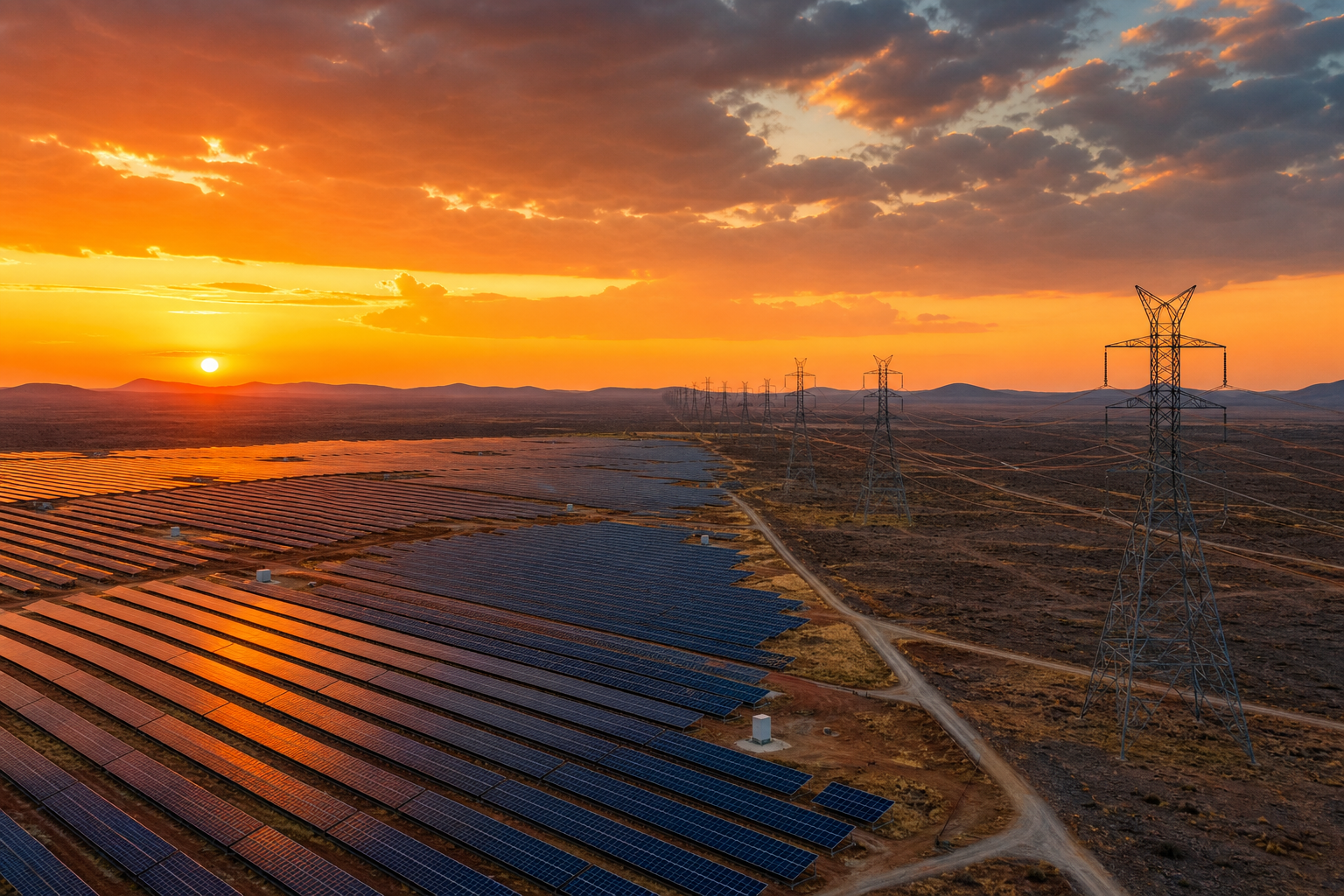
South Africa's energy transition has crossed a milestone that demands a fundamental reassessment of how commercial and industrial (C&I) electricity buyers evaluate site selection, PPA tenor, and capital allocation. South Africa has surpassed 10.12 GW of installed solar PV capacity, representing 19% year-on-year growth. That number is not simply a badge of continental leadership — it is the new grid-access ceiling against which every wheeling buyer in the Northern Cape, Western Cape, and Eastern Cape must now calibrate their financial models before executing a single site-selection decision.
The triumphant narrative of solar abundance obscures a structural constraint that is already reshaping project economics: South Africa's electricity problem has moved from power stations to power lines. For CFOs and property managers locking in long-dated offtake commitments in Q4 2026, that shift has direct, material consequences.
The REIPPPP BW7 Solar-Bid Overflow: A Market Signal, Not a Milestone
The most instructive data point for C&I buyers in 2026 is not the headline capacity figure — it is what happened inside REIPPPP Bid Window 7. BW7 was released in December 2023, targeting up to 5,000 MW (1,800 MW solar PV and 3,200 MW of wind). The market's response shattered those parameters entirely. The 5 GW auction round was oversubscribed, with 10.2 GW worth of bid responses received — 40 for solar PV and 8 from onshore wind projects.
The solar overflow is staggering: BW7 revealed an undersubscription for wind technology at 1,692 MW, while solar PV was oversubscribed with a total of 8,526 MW of capacity submitted. Only a fraction of that solar appetite could be accommodated. South Africa selected 8 projects as the preferred bidders for 1.76 GW of solar PV capacity under the REIPPPP BW7 auction, with winning bids ranging from ZAR 420.74/MWh to ZAR 492.20/MWh. The gap between 8,526 MW submitted and 1,760 MW awarded is not a procurement inefficiency — it is a direct reflection of how little transmission corridor capacity remains available in the country's highest-irradiance provinces.
The pattern continued into BW7.3. NERSA approved generation licences for four large solar PV projects in July 2026, selected under Bid Window 7.3 of the REIPPPP, together adding a contracted capacity of 890 MW to South Africa's electricity system. Each successive sub-round confirms the same structural reality: solar development appetite vastly exceeds the grid's ability to absorb new connections in the preferred development corridors.
"Grid capacity limitations were the primary reason zero wind projects were awarded in REIPPPP 7, and are increasingly constraining solar development," according to SAPVIA spokesperson Frank Spencer. For C&I wheeling buyers, the absence of wind in BW7 is the canary in the coal mine. Wind requires the same transmission corridors your solar wheeling route depends on — and those corridors are already spoken for.
The NTCSA's 14,450 km Target Versus the Reality on the Ground
The NTCSA's Transmission Development Plan (TDP) is the policy framework that theoretically resolves the grid-access ceiling. The numbers are ambitious. The revised 2025–2034 TDP projects that 56 GW of new generation capacity will be integrated between 2025 and 2034, which will require 14,500 km of new transmission lines, along with 210 transformers providing 113,000 MVA of capacity. The investment requirement is correspondingly enormous: the Transmission Development Plan for 2025–34 sets out the construction of 14,500 km of new transmission lines and expanded transformer capacity, placing the investment requirement at about R440 billion.
The gap between ambition and execution, however, is the defining risk variable for any C&I PPA signed today. The NTCSA confirmed recently that only 270.8 km of transmission lines were constructed in its 2025/26 financial year against a target of 423 km, attributing the deficit largely to contractor financial constraints and underperformance on several projects. Measured against the 14,500 km programme target, this mid-year shortfall of approximately 152 km — roughly 108 km short of run-rate pace needed to meet the 10-year plan — is not a minor scheduling variance. It signals a systemic execution risk that will ripple directly into connection queue timelines for every new C&I project banking on grid access in the next 24–36 months.
NTCSA CEO Monde Bala confirmed that the country had been delivering transmission infrastructure at about 250 km a year over the past decade — and that this needed to increase seven to ten times to meet the plan's requirements. To put that in context: Eskom could only build 74 km of new transmission lines in the 2023/2024 financial year, and South Africa's entire existing transmission system of 33,000 km was built over a century.
The funding architecture compounds the execution challenge. The NTCSA needs to close a funding gap of about R134 billion over the next five years, with CEO Monde Bala stating the NTCSA cannot deliver the entire programme on its own and needs support from international partners. The intention is for about 70% of the transmission expansion programme to be delivered by NTCSA, with about 30% delivered through the Independent Transmission Programme and private sector participation — translating into about 4,000 km of transmission infrastructure being delivered through private sector involvement.
What This Means for Northern Cape, Western Cape, and Eastern Cape Site Selection
The three provinces that dominate C&I solar wheeling pipelines are also the three provinces bearing the greatest transmission congestion pressure. Network expansion is focused on strengthening the system, particularly in the Western Cape, Eastern Cape, and KwaZulu-Natal — but "focused expansion" in a context of chronic build shortfalls means relief is measured in years, not months.
For CFOs evaluating site selection in Q4 2026, the practical implications are as follows:
- Northern Cape: Highest irradiance in southern Africa, but transmission corridors from Loeriesberg and Pofadder substations are heavily booked by REIPPPP-awarded utility-scale projects. New C&I applications face queue competition from projects that secured preferred bidder status in BW7 and BW7.3. Expect 18–36 month connection timelines from application to energisation for new wheeling routes without pre-existing grid access agreements.
- Western Cape: Municipal wheeling frameworks are the most commercially mature in the country, but substation capacity at Proteus and Muldersvlei is constrained. Eskom's transmission division manages a connection queue that, as of 2025, contains over 80 GW of applications, creating 3–5 year connection timelines for new utility projects at congested nodes.
- Eastern Cape: Strong wind and solar resource, but the province saw BW6 wind awards blocked entirely due to confirmed grid unavailability — a precedent that should inform any greenfield solar wheeling assessment. Grid reinforcement projects are in execution phase but subject to the same contractor-performance risks that drove the FY2025/26 build shortfall.
PPA Tenor Risk: The Repricing Imperative
The combination of a saturated installed base, an oversubscribed bid pipeline, and a chronically under-resourced transmission build programme creates a specific and underappreciated risk for C&I buyers: PPA tenor mis-pricing.
A 10–15 year fixed-price wheeling PPA that was structured on the assumption of a 6–12 month connection timeline must now be repriced against the reality of 24–48 month grid connection queues. The financial consequences are direct: delayed connection shifts the break-even point on capital recovery, erodes the NPV of avoided-cost savings, and — for property managers with tenants anchored to green energy commitments — creates reputational and contractual exposure if commercial operation dates slip.
Third-party wheeling — transmitting privately generated electricity across the Eskom grid to a remote offtaker — is now legally permissible but commercially complex, with wheeling charges varying by municipality and Eskom zone. The National Energy Regulator of South Africa (NERSA) is developing a standardised wheeling tariff framework, expected to be finalised in 2026–2027. Until that standardisation arrives, every wheeling PPA carries embedded tariff-revision risk that must be stress-tested across the full tenor of the agreement.
BESS Co-Location: From Optional Feature to Connection Prerequisite
The grid saturation dynamic has elevated Battery Energy Storage Systems (BESS) from a value-add option to a near-mandatory co-location requirement for new C&I solar projects in constrained corridors. The logic is straightforward: BESS enables time-shifting of generation away from midday solar peaks — precisely the window during which the grid is most congested — into evening demand hours, reducing the peak export burden on constrained transmission infrastructure and improving the commercial case for grid operators to approve new connections.
BESS co-location also directly addresses the PPA tenor risk identified above. A project with dispatchable storage capability commands a stronger bankability position, is more likely to secure a shorter connection queue position, and can offer offtakers a higher guaranteed energy delivery ratio across variable irradiance conditions. For CFOs modelling 12–15 year PPA commitments, the incremental capital cost of co-located BESS — typically 15–25% of total project capex at current lithium iron phosphate (LFP) pricing — must be weighed against the avoided cost of delayed connection, tariff-revision exposure, and the competitive disadvantage of a non-dispatchable supply contract in a market moving rapidly toward round-the-clock green energy procurement requirements.
Practical Recommendations for Q4 2026
Given the convergence of solar saturation, BW7's solar overflow, and the NTCSA's demonstrable build shortfall, CFOs and property managers must take the following steps before executing any C&I wheeling agreement:
- Conduct a Grid Capacity Corridor Audit Before Site Selection: Require your developer or advisor to provide substation-level capacity data, cross-referenced against current CEL (Connection Enquiry Letter) application volumes and REIPPPP-awarded project connection schedules. Site selection must be grid-first, not irradiance-first.
- Build Connection Timeline Contingency Into PPA Financial Models: Model 24, 36, and 48-month connection scenarios and their NPV impact before executing heads of agreement. The 10-year payback assumption standard in 2022–2024 models is no longer defensible without transmission corridor verification.
- Insist on BESS Co-Location Feasibility Analysis as a Pre-Contractual Deliverable: Any project developer that cannot provide a storage co-location analysis as part of the prefeasibility package is not pricing the true connection risk into their proposal.
- Assess Municipal vs. Eskom Wheeling Route Viability: Wheeling agreement negotiation takes 6–18 months with municipalities, many of which resist wheeling because it reduces their electricity sales revenue. The route with the lowest wheeling tariff is not always the route with the fastest or most certain execution pathway.
- Structure PPA Agreements with Force Majeure and Connection Delay Provisions: Grid connection delays attributable to NTCSA build shortfalls or queue congestion should be explicitly carved out as excusable delay events, with back-stop date provisions that protect both buyer and seller from stranded capital exposure.
- Monitor ITP Programme Milestones as Leading Indicators: The first phase of the Independent Transmission Programme covers 1,164 km of transmission infrastructure, with future phases required to support the broader transmission build. ITP milestone delivery — or slippage — is your earliest indicator of whether the TDP build rate is accelerating or compounding its shortfall.
The Bottom Line for C&I Decision-Makers
South Africa's 10.12 GW solar milestone is real, and the C&I sector's role in achieving it deserves recognition. Solar PV has emerged as the primary driver of new generation capacity nationwide, supported by strong public and private investment across utility-scale, commercial and industrial, and distributed generation segments. But the next phase of C&I solar value creation will not be won by buyers who move fastest on site selection — it will be won by those who price grid access as the scarce commodity it has become.
The NTCSA's 108 km mid-year build shortfall against a 14,500 km target, BW7's 8,526 MW solar overflow against a 1,800 MW procurement window, and an 80+ GW national connection queue are not abstract policy risks. They are balance-sheet events waiting to materialise in PPA agreements signed without grid-first due diligence. In Q4 2026, the CFO who treats transmission corridor booking as a secondary commercial consideration is the CFO who will be explaining delayed CODs and stranded capex to their board in 2028.
At SolarXgen, every C&I site assessment now includes a mandatory grid capacity layer — mapped against the latest connection data and cross-referenced against REIPPPP allocation decisions. We design around transmission reality from day one, because in today's South African energy market, megawatts mean nothing without a wire to carry them.
Sources & References
- SAPVIA — "South Africa's Solar PV Industry Surpasses 10 GW Milestone" (July 2026)
- PV Magazine — "South Africa Adds 1.6 GW of Solar in 2025" (February 2026)
- PV Magazine — "South Africa's Solar Industry Must Focus on Execution" (February 2026)
- TaiyangNews — "Solar Wins South Africa's REIPPPP 7 Renewable Energy Auction" (December 2024)
- GrantZA — "REIPPPP 2026 Programme Overview"
- SolarQuarter — "NERSA Approves 890 MW Under REIPPPP BW7.3" (July 2026)
- Green Building Africa — "REIPPPP BW7: Wind Undersubscribed, Solar Massively Oversubscribed" (August 2024)
- Engineering News — "NTCSA, IDC Seek to Catalyse Localisation on Grid Roll-Out" (May 2026)
- Business Day — "NTCSA Seeks R134bn to Fast-Track Transmission Grid Expansion" (August 2026)
- Daily Maverick — "SA's Transmission Build Opens a R440bn Test for Private Capital" (June 2026)
- Financial Mail — "No Grid, No Growth: South Africa's Transmission Crunch" (September 2026)
- Green Building Africa — "NTCSA Transmission Development Plan 2025–2034 Presentation" (October 2024)
- eFinancialModels — "South Africa Solar Energy Investment Guide 2026–2031" (June 2026)
- The Newspaper ZA — "SA's Grid Reform Takes Centre Stage at Windaba 2026" (September 2026)