South Africa's 10 GW Solar Milestone Is Now a Grid-Saturation Warning for C&I Buyers: What the Fully Booked Northern Cape, Western Cape, and Eastern Cape Transmission Corridors Mean for New Project Bankability, Site Selection, and PPA Tenor in H2 2026
South Africa has crossed 10.12 GW of installed solar PV capacity — but for C&I energy buyers, the milestone doubles as a warning: the Northern Cape, Western Cape, and Eastern Cape transmission corridors are fully booked, and grid saturation is now the single biggest variable shaping project bankability, site selection, and PPA structure in H2 2026.
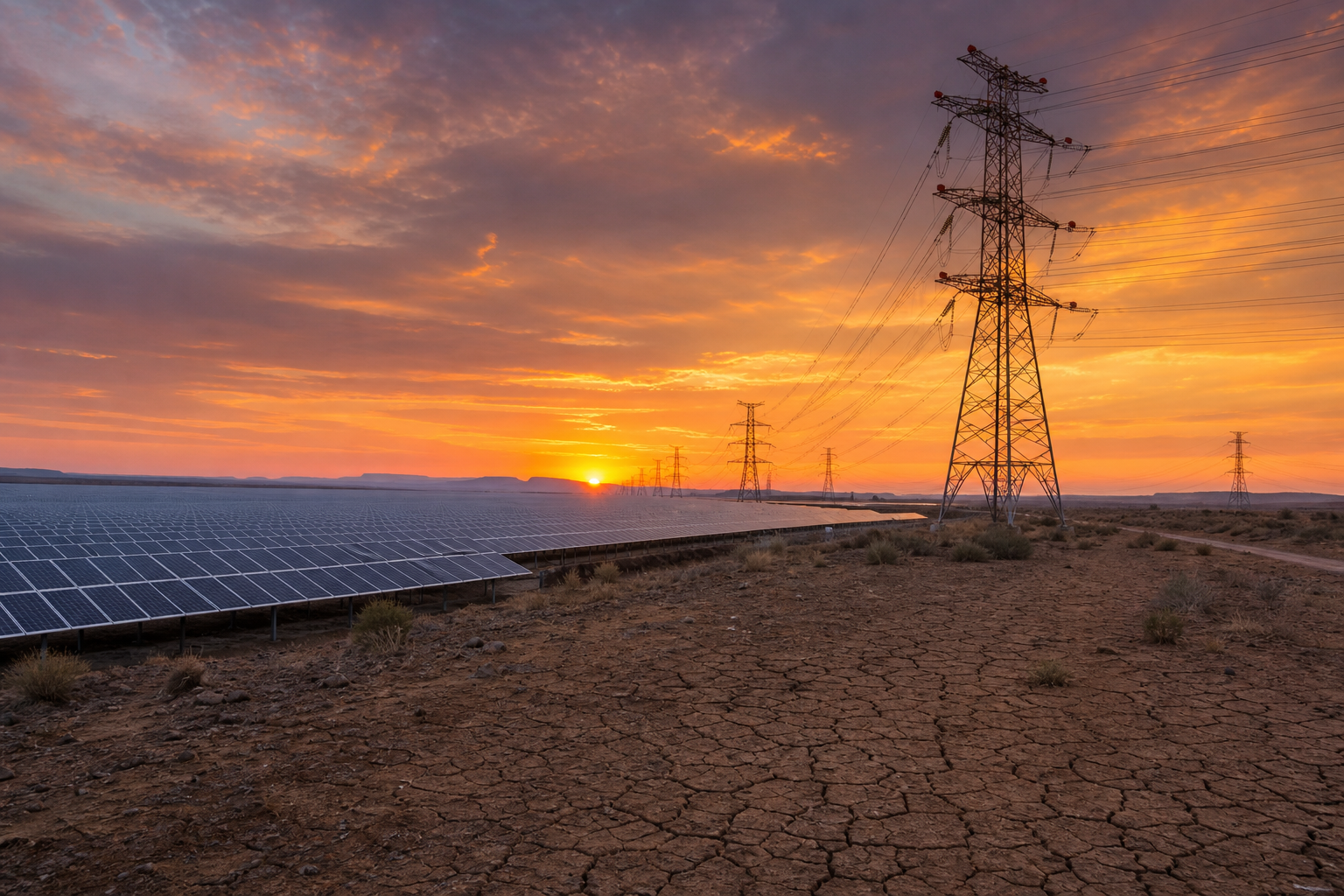
From Milestone to Warning Sign: South Africa's 10 GW Solar Achievement Has a Grid-Sized Caveat
South Africa's solar sector just delivered the headline the industry has been waiting years to write. The South African Photovoltaic Industry Association (SAPVIA) confirmed in its Annual Report for the 2025/26 financial year that the country has surpassed 10.12 GW of installed solar PV capacity, representing 19% year-on-year growth. The milestone cements South Africa's position as Africa's leading solar market and one of the top 20 globally, with solar PV now the primary driver of new generation capacity — supported by strong public and private investment across utility-scale, C&I, and distributed generation segments.
For Commercial & Industrial (C&I) energy buyers, the instinct is to celebrate. The reality, however, is more complicated — and significantly more urgent.
The Grid Was Never Built for This Moment
South Africa's electricity grid was never designed to support a decentralised, renewable-powered economy. Originally built to transmit power from centralised coal-fired power plants in specific regions, the grid is now overwhelmed by a surge of wind and solar projects seeking connection. The grid was built for coal plants clustered in Mpumalanga, not for the wind and solar potential in the Northern, Eastern, and Western Cape.
The consequences are now structural and measurable. Eskom's Generation Connection Capacity Assessment (GCCA) found that the generation connection capacity has been depleted in the Northern Cape, Western Cape, and Eastern Cape — some of the most favourable areas for wind and solar PV generation — with many projects denied a connection because there is currently no capacity on the transmission network to accommodate them.
These renewable energy corridors currently face severe transmission constraints, with available grid capacity largely exhausted. As a result, several gigawatts of wind and solar projects remain unable to connect to the system. In a particularly stark indicator of market pressure, the Western Cape alone has seen around 18,000 MW of interest expressed, but the province currently has a "negative grid availability."
The Curtailment Framework: Relief, Not Resolution
Regulators have stepped in with a temporary fix. NERSA approved an application by the National Transmission Company of South Africa (NTCSA) for a congestion curtailment framework, classified as a constrained generation ancillary service — a regulatory mechanism that empowers the NTCSA to restrict the amount of power exported by generators at times when the transmission infrastructure is unable to accommodate all of the electricity being generated, in order to free up capacity for other generators or maintain system stability.
The GCCA Addendum suggested that by accepting a reasonable share of no more than 10% curtailment, 3,470 MW of additional wind generation can be connected to the grid almost immediately — 2,680 MW in the Western Cape and 790 MW in the Eastern Cape. The approval is valid from 1 April 2025 to 31 March 2028, after which it will be reviewed.
For C&I buyers, this matters enormously: curtailment risk is now a live contract variable, not a theoretical footnote. Any wheeled PPA drawing power from a congested corridor carries embedded generation risk that must be explicitly addressed in offtake agreements.
What This Means for New Project Bankability in H2 2026
Industry experts are blunt: "Projects fail because the offtake is weak, because grid access is uncertain, because development capital is insufficient, because the funds underestimate transmission risk, or because the risk allocation between parties is fundamentally unbankable." In a grid-saturated landscape, these are no longer edge-case risks — they are the baseline.
The country's renewable energy generation capacity and project development pipeline is now heavily imbalanced towards solar, which only functions in daylight — and daytime electricity generation capacity is poised to exceed daytime energy demand, which will require the excess electricity generation to be curtailed. This daytime saturation effect is a direct bankability threat for new projects relying on simple, unhedged solar-only generation profiles.
The good news: models like Lyra Energy — a joint venture between Scatec, Standard Bank, and Stanlib — are demonstrating a viable path, building utility-scale solar plants and selling output to multiple C&I customers through flexible, pooled PPAs. In February 2026, Lyra signed offtake agreements with three top-tier C&I buyers covering most of the power from its 255 MW Thakadu solar plant. Mid-sized companies that lack the balance sheet or technical capacity to develop a 100+ MW project on their own can buy clean power at utility-scale economics through a single contract — bypassing the strained national grid entirely.
Site Selection and PPA Tenor: The New Calculus for C&I Buyers
With the Cape corridors effectively full, Eskom's Grid Planning Manager has pointed to Mpumalanga as the next space to face severe congestion, now that promotion of grid integration in that area has sparked significant new interest, with 80% of demand load coming from the north but 52% of anticipated generation growth expected from the south of the country. C&I buyers and their developers must now treat grid node availability as a primary site selection criterion — ahead of irradiance, land cost, or proximity to load.
On PPA tenor, the market is bifurcating. Developers like Sosimple Energy have introduced five-year solar PPAs for the C&I sector — the first short-term offering of its kind in a market where most solar PPAs are typically structured over 10 to 20 years. This signals a market response to grid uncertainty: shorter tenors reduce long-term curtailment exposure for buyers, but transfer re-pricing risk back into the energy cost equation.
For larger C&I users with appetite for longer commitments, rolling out transmission programmes takes considerable time, and the near-term answer lies in storage as part of the mix, alongside hybrid plants and flexible dispatch offerings, to relieve some congestion while pursuing the bigger infrastructure programme. Solar-plus-BESS configurations are no longer a premium option — they are rapidly becoming the minimum viable structure for a bankable, grid-compliant project in H2 2026.
The Broader Infrastructure Fix: Years Away
According to Eskom, more than R388 billion is needed to upgrade and modernise the country's transmission and distribution infrastructure. The Independent Transmission Project (ITP) model, currently being developed with World Bank support, offers a credible long-term pathway — enabling private developers to finance, build, and operate transmission lines before transferring them back to Eskom, unlocking capital without sacrificing long-term national control. But these are multi-year programmes. The constraint is real today.
The SolarXgen Perspective: Act Now, Structure Smartly
South Africa's 10 GW milestone is a genuine achievement. But for C&I energy users evaluating new solar projects in H2 2026, it is also a clear signal: the era of easy grid connection is over. The buyers who lock in well-structured, grid-aware, storage-paired PPAs in the next 12 months will be the ones who capture the best economics before the next wave of project backlogs materialises. The pipeline is enormous — the SAREGS 2025 survey revealed a national renewable energy pipeline exceeding 220 GW, with over 46 GW of advanced-stage solar projects proposed for grid connection by 2030 — but grid capacity will not grow at the same pace. Site selection, curtailment clauses, tenor flexibility, and BESS co-location are now the four pillars of every bankable C&I solar deal in South Africa.
Sources & References
- Business Tech Africa — SAPVIA Annual Report 2025/26: South Africa surpasses 10 GW solar milestone (July 2026)
- PV Magazine — South Africa adds 1.6 GW of solar in 2025 (February 2026)
- Green Building Africa — South Africa's grid bottleneck: Eskom, legal battles, and the fight for transmission access (March 2026)
- Fasken — Congestion curtailment approved by NERSA (July 2025)
- Pinsent Masons — NERSA decision unlocks wind generation in Eastern and Western Cape (October 2025)
- CNBC Africa — South Africa's energy goals depend on grid expansion (July 2025)
- Engineering News — South Africa facing major mismatch between renewable energy and grid management (June 2026)
- Engineering News — Grid Up (February 2026)
- VUKA Group — SA transmission grid planning about to go into high gear
- African Exponent — Africa's hidden solar boom: C&I platforms consolidating a 40 GW market (May 2026)
- ESS News — Battery storage key to solar project bankability in Africa (May 2026)
- Energize — Short-term solar PPA launched for C&I sector (June 2025)
- Prospect Intel — 3 power transmission projects to watch in South Africa (April 2026)
- Daily Maverick — South Africa's electricity crisis: the grid is the real threat to energy security (April 2025)