South Africa's 5,700 MW Wheeling Financial-Close Sprint Is Now the Capacity-Allocation Race Every C&I Buyer Must Win Before Year-End: What the Near-Doubling of Projects Financed Versus 2025, the 19.3 GW NERSA Registration Queue, and the 30-Project Final-Financing Pipeline Mean for Grid-Access Pricing, PPA Tenor, and Site-Selection Urgency in H2 2026
South Africa's wheeling sector is racing toward 5,700 MW of financial closes in 2026 — nearly double last year — as 30 large projects sprint to year-end funding and a 19.3 GW NERSA registration queue signals a grid-access crunch that every C&I energy buyer must act on now.
South Africa's 5,700 MW Wheeling Financial-Close Sprint: The Capacity-Allocation Race Every C&I Buyer Must Win Before Year-End
South Africa's private power market has entered its most consequential half-year in history. The numbers are staggering, the pipeline is real, and the window for commercial and industrial (C&I) energy buyers to secure grid-connected solar capacity on favourable terms is closing fast.
The Pipeline at a Glance
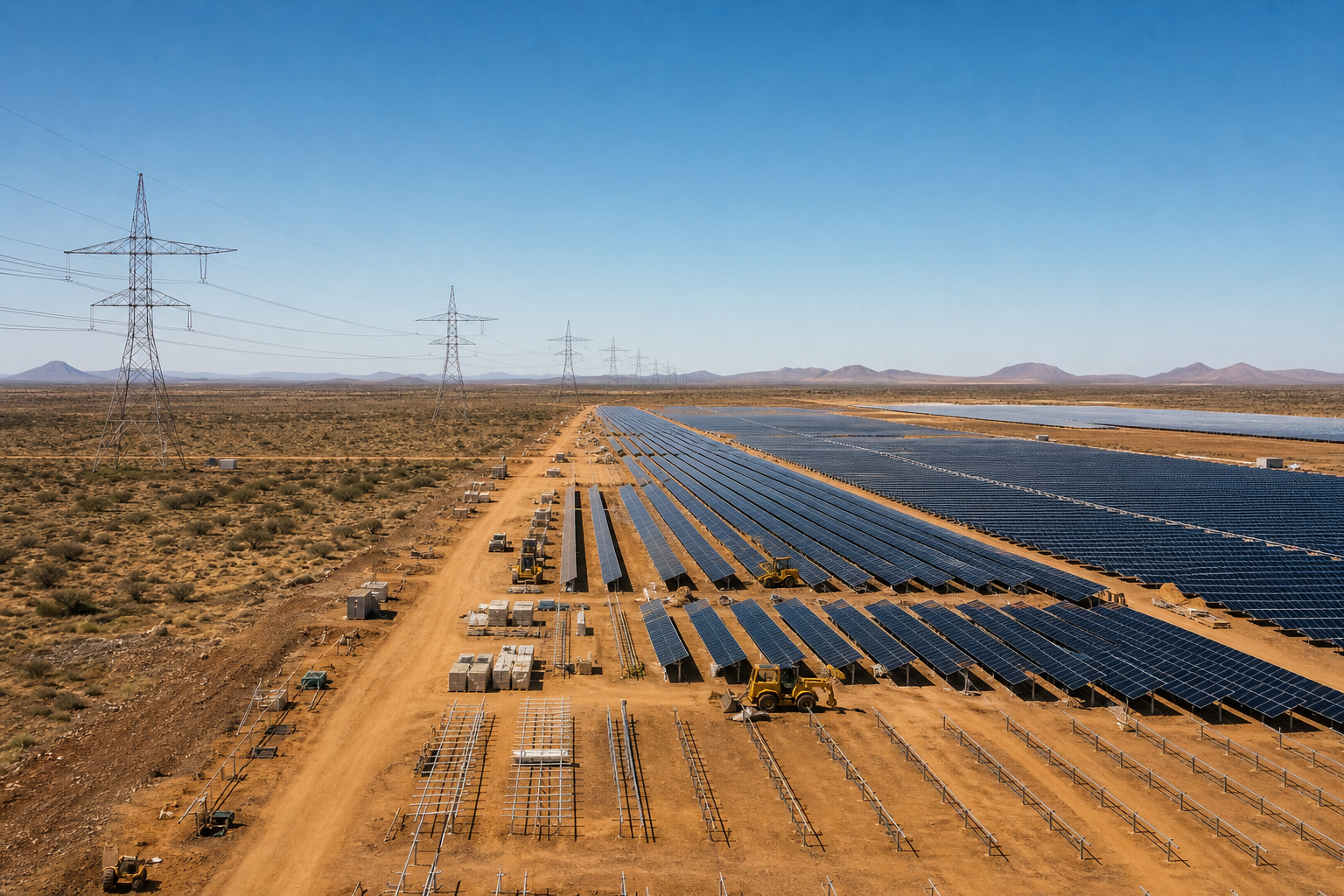
If the current pipeline of some 30 large projects in the final stages of financing converts, South Africa's wheeling industry is on track to bank more than 5,700 MW this year — nearly double the number of projects financed in 2025. This is not speculative optimism. South Africa is on track for its strongest-ever year of independent power producer additions, with new research from the Power Futures Lab at the UCT Graduate School of Business confirming unprecedented deployment momentum — with 17 IPP projects totalling 1,920 MW entering commercial operation in the first six months of 2026, marking the largest half-year additions in the country's history.
Data compiled by the Power Futures Lab at the University of Cape Town indicates that six major projects, totalling 1,788 MW, reached financial close during the first months of 2026. The race to close the remaining 30 projects before year-end is now the defining commercial contest in South Africa's energy sector.
The 19.3 GW NERSA Queue: What It Really Means
As of May 2026, the National Energy Regulator of South Africa registered over 19.3 GW of new generation facilities, with the vast majority specifically intended for wheeling to private buyers, according to data collated by the Power Futures Lab. On its own, this sounds like an abundance of supply. In reality, it represents the opposite: a capacity-allocation crunch.
South Africa has an oversupply of renewable energy projects under development with limited grid access — meaning that a project registered with NERSA is far from guaranteed a viable transmission slot. The Grid Capacity Allocation Rules (GCAR) formalise readiness-based allocation and queue management for scarce grid capacity, replacing the Interim GCAR introduced by Eskom. For C&I buyers, this means the site a project occupies on the grid — and its readiness relative to competitors — now directly determines whether power can be delivered under a PPA at all.
Grid registration activity continues at pace. NERSA registered 124 electricity generation facilities during the first quarter of the 2026/27 financial year (April to June 2026), with a combined generation capacity of 804 MW representing an estimated investment of R20.18 billion. NERSA processed applications within an average of 10 working days, improving on the 11 working day average recorded in the same quarter of the prior year.
Landmark Deals Setting the Benchmark
Two recent financial closes illustrate the scale and structure of what is now bankable in South Africa:
- SunCentral Phase 1 (342 MW) — SolarAfrica: SolarAfrica reached financial close on SunCentral 3, the third and final 114 MW facility of Phase 1, with funding provided by RMB and Investec Bank, completing a 342 MW generation capacity tranche to be wheeled through South Africa's national grid. SunCentral is structured as a utility-scale solar PV plant for multiple off-takers under a one-to-many wheeling model — a structure now considered the gold standard for C&I delivery. The first 114 MW is expected to come online during the second half of 2026, and once complete, SunCentral will deliver up to 1 GW of renewable energy capacity.
- Naos 1 Hybrid (300 MW solar + 660 MWh BESS) — SOLA Group: The 300 MW solar facility, with 435 MWp installed capacity and 660 MWh of battery storage, has reached financial close and commenced construction, backed by long-term power purchase agreements with Sasol and Air Liquide. It is the first utility-scale solar PV and battery project purpose-built to wheel electricity across the national grid to private end-users, with the plant able to store daytime production and dispatch it during evening peak demand.
Implications for C&I Property Owners: Three Urgent Pressure Points
1. Grid-Access Pricing Is Rising as the Queue Fills
With 19.3 GW of registered projects competing for constrained transmission slots under the GCAR's readiness-based allocation rules, wheeling charges and grid-access premiums are tightening. C&I buyers who delay site selection risk paying a higher grid-access tariff — or finding their preferred node already allocated to a competitor project. In 2026, trader-led wheeling is poised to become the dominant commercial model in the South African private power market, and traders are pricing scarcity into the deals they aggregate.
2. PPA Tenor: 20 Years Is Now the Market Standard
Through long-term trading agreements lasting 20 years or more, energy traders purchase electricity from generators and supply it to commercial and industrial customers across the country. Long-dated PPAs with fixed escalation clauses insulate off-takers from the volatility of Eskom tariff hikes, which rose 12.7% in April 2026 alone. C&I property owners holding out for shorter, cheaper contracts are leaving long-run savings on the table while Eskom tariffs compound.
3. BESS Integration Is No Longer Optional
Phase 2 of the SunCentral development and projects like Naos 1 signal an unmistakable market direction. Future phases of large wheeling projects are expected to incorporate hybrid solar and battery energy storage, extending clean power beyond daylight hours. Hybrid solar and storage projects are proving dispatchable renewables can serve heavy industry at scale. For C&I buyers, a PPA that lacks an associated BESS component increasingly means exposure to evening peak Eskom pricing — the very hours when Eskom's tariffs bite hardest.
Municipal Risk: The Hidden Threat to Wheeling Certainty
Municipal financial instability and distribution-level constraints have been highlighted by industry stakeholders as emerging challenges for electricity market reform, particularly in relation to wheeling and customer access to alternative supply. Properties served through financially distressed municipalities face an additional layer of wheeling settlement risk that makes direct Eskom transmission connection — where feasible — a superior site-selection criterion in H2 2026.
The SolarXgen Takeaway
The 5,700 MW financial-close sprint is not a distant aspiration — it is happening now, project by project, across South Africa's Northern Cape, Free State, and Western Cape grid nodes. C&I property owners who move in H2 2026 can still access funded solar at competitive PPA rates, with grid-allocation certainty, BESS optionality, and 20-year price protection. Those who wait for a less crowded market may find that both the grid capacity and the best-priced PPAs have already been allocated to businesses that moved earlier.
Act now: SolarXgen's project finance and PPA structuring team is actively securing capacity allocations across South Africa's key wheeling corridors. Contact us today to assess your site's grid position before the year-end sprint closes.
Sources & References
- Green Building Africa — "South Africa on course for record IPP year as 4,123 MW targets commercial operation in 2026" (August 2026)
- Energize — "Opinion: Wheeling comes of age in South Africa" (June 2026)
- Construction Safety — "SolarAfrica completes first 342 MW phase of flagship wheeling project" (August 2026)
- Green Building Africa — "Trader-led wheeling and heavy industry NPAs crossroads" (February 2026)
- Green Building Africa — "NERSA registers 124 power generation facilities with 804 MW capacity in Q1 2026/27" (August 2026)
- Cliffe Dekker Hofmeyr — "NERSA ramps up decision-making to enable grid access and increase market competitiveness"
- SolarQuarter — "Anthem Renewable Energy Secures Financial Close for 475 MW Notsi Solar Project" (March 2026)
- Energize — "Wheeling ambitions collide with municipal financial strain" (January 2026)
- GreenCape — Renewable Energy Market Intelligence Report South Africa 2026