South Africa's Transmission Deployment Crisis Is Now the Invisible Ceiling on Every New C&I Wheeling Contract: What the NTCSA's 14,450 km Grid Build Target, Its 108 km FY2026 Completion Rate, and the Resulting Congestion Queue Mean for Project Bankability, PPA Tenor, and Site-Selection Strategy in H2 2026
South Africa's NTCSA has a 14,450 km transmission build target but completed just 108 km by mid-FY2026 — a delivery gap that is now the invisible ceiling on every new C&I wheeling contract, forcing C&I energy buyers to rethink PPA tenor, site selection, and bankability strategy in H2 2026.
The Grid Is the New Load-Shedding: How South Africa's Transmission Crisis Is Quietly Killing C&I Wheeling Deals
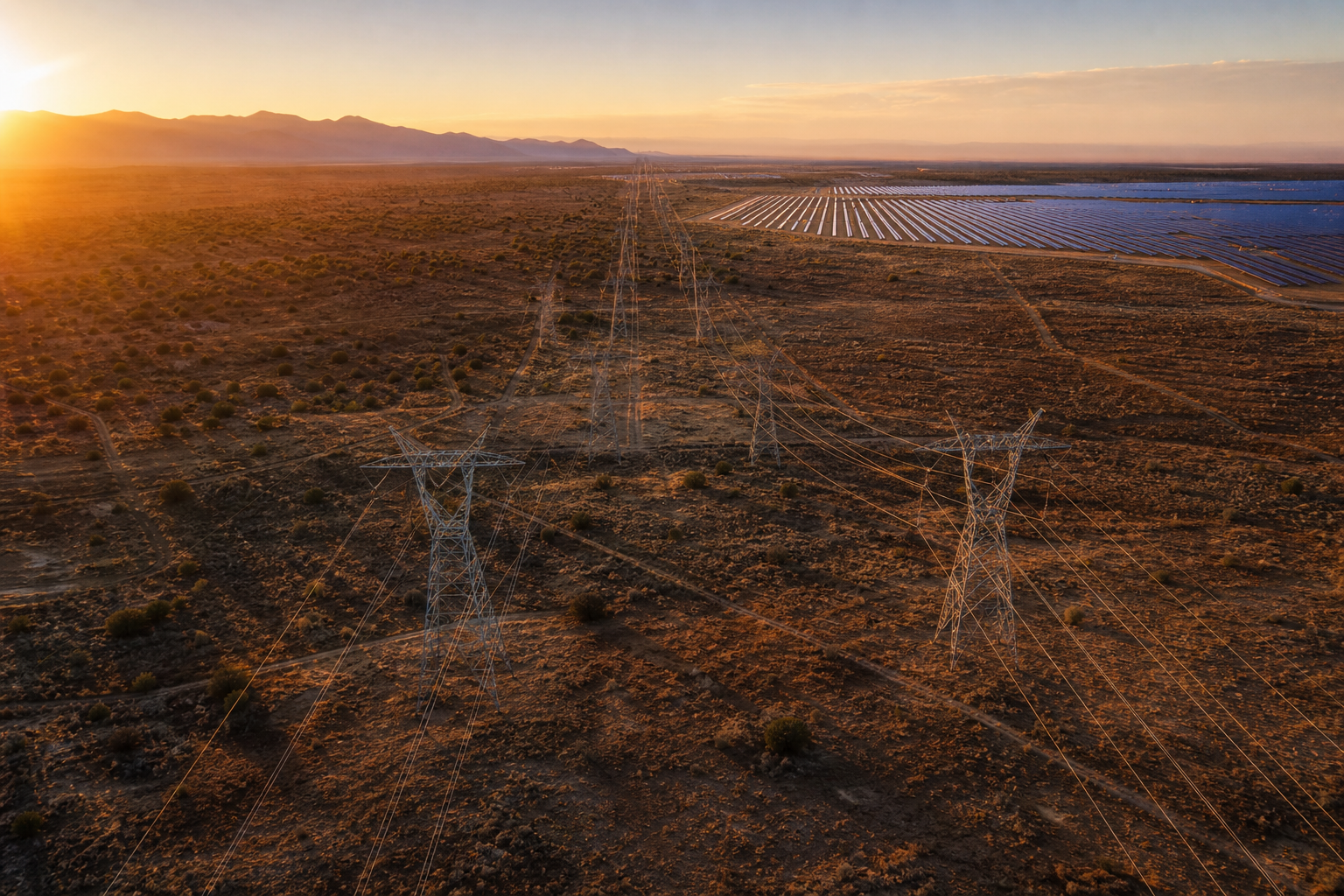
South Africa successfully shifted the energy conversation away from load-shedding. The new crisis is quieter, more structural — and arguably harder to fix. The country's energy debate has moved from power stations to power lines, with the grid now emerging as the next binding constraint. For commercial and industrial (C&I) energy buyers pursuing wheeling contracts in H2 2026, the transmission bottleneck has become the single greatest threat to project bankability, PPA pricing certainty, and site-selection strategy.
The Numbers That Tell the Story
The NTCSA's Transmission Development Plan (TDP), unveiled in October 2024, sets out an ambitious construction commitment of 14,450 km of new transmission lines and 210 transformers, designed to bring the required 56 GW of new generation capacity online. The programme carries an estimated cost of R440 billion over 10 years.
The delivery gap, however, is staggering. According to the SAETA report, the NTCSA's FY2025/2026 target is 423.1 km, with just over 108 km completed as of October 2025. To put that in perspective, the country has been delivering transmission infrastructure at about 250 km a year over the past decade — and meeting the plan's requirements would demand an increase of seven to ten times that rate. As one industry leader put it plainly: "We need to do a minimum of about 2,000 km a year. It's a huge task."
The Congestion Queue: Where C&I Projects Go to Wait
The delivery shortfall has produced a very real phenomenon: grid saturation in the very regions where renewable energy is most abundant. With 75% of all private renewable applications located in either the Eastern, Western, or Northern Cape, these areas are grid-saturated — there is nowhere for the power to go.
The 2025 South African Renewable Energy Grid Survey (SAREGS) identified a total renewable energy pipeline exceeding 220 GW — an 86 GW increase on 2024 — with over 46 GW of advanced-stage solar PV projects proposed for grid connection by 2030. The disparity between this pipeline and the actual rate of transmission build is stark. South Africa has an oversupply of renewable energy projects under development with limited grid access, meaning investment in late-stage developments lowers the risk of a potentially stranded asset.
The NTCSA has responded with an interim congestion management tool. Transmission and distribution capacity remain the binding bottlenecks, and while the approved Congestion Curtailment Proposal aims to unlock approximately 3.4 GW of grid capacity in constrained regions by allowing managed curtailment, grid limitations persist. For a C&I offtaker signing a long-term PPA, contractual curtailment exposure is not a theoretical footnote — it is a bankability question lenders are now asking upfront.
What This Means for PPA Tenor and Bankability
The transmission crunch is reshaping PPA structuring in three measurable ways:
- Curtailment risk clauses are non-negotiable. Project lenders are requiring explicit contractual treatment of curtailment events before advancing debt. Any PPA that does not allocate curtailment risk between generator and offtaker will face financing hurdles.
- PPA tenors are being stress-tested against grid timelines. South Africa's slow pace of transmission deployment remains a significant risk to energy security and decarbonisation efforts, meaning that a 10- or 15-year PPA must account for the probability that wheeling capacity at the nominated node improves — or does not — within its term.
- The SAWEM delay compounds price uncertainty. The implementation of SAWEM has been delayed until Q3 2026, and for energy management professionals, grid planners, and project developers, this delay is a significant disruption to how we engineer, finance, and operate energy assets across the country. Without nodal pricing signals, the delay of SAWEM masks congestion price signals, and we lack the financial transparency required to unlock private transmission financing models.
The GAU Conflict of Interest: A Structural Drag on Wheeling Approvals
Beyond physical grid constraints, a governance problem is slowing wheeling approvals at the connection layer. The Grid Access Unit (GAU) sits inside the very business that collects retail revenue, so every wheeling connection it approves for a non-REIPPPP project erodes the income of the entity it reports to — creating a clear conflict of interest that, combined with its lack of authority over NTCSA resources it relies on for connection designs, breeds delay and perverse incentives. Nersa formally gazetted the permanent Grid Capacity Allocation Rules (GCAR) in late December 2025, replacing Eskom's interim framework with a transparent, legally sound "first-ready, first-served" allocation mechanism — a meaningful regulatory win, but one that still depends on the GAU executing without institutional friction.
Site-Selection Strategy for H2 2026: What C&I Buyers Must Do Now
For C&I energy users negotiating or renewing wheeling contracts in the second half of 2026, the transmission reality demands a more sophisticated site-selection and contractual approach:
- Node-level due diligence is essential. Grid capacity limitations have slowed the integration of new generation projects in provinces such as the Western Cape, Eastern Cape, and KwaZulu-Natal. Buyers must request node-specific capacity data before committing to a supply point.
- Prioritise projects with self-funded grid infrastructure. Developers who invest in their own Main Transmission Substations — as SolarAfrica did by investing a portion of its $94 million funding directly into a Main Transmission Substation engineered to handle up to 2 GW of power evacuation — offer meaningfully lower connection risk.
- BESS co-location reduces curtailment exposure. Strategically placed storage at congested substations absorbs power the network cannot evacuate and releases it when lines have headroom, unlocking capacity years before new infrastructure can be permitted and built, at a materially reduced cost. C&I buyers should actively favour IPPs offering hybrid solar-plus-BESS configurations.
- Consider trader-led, portfolio-based models. Trader-led wheeling has become the default model. Under this model, licensed traders sit between independent power producers and end-users, coordinating supply and demand across portfolios — diversifying node exposure and reducing single-point curtailment risk for the offtaker.
- Factor ITP progress into long-term PPA assumptions. The Independent Transmission Projects (ITP) programme enables private players to finance, design, build, and operate transmission infrastructure, with the pilot phase alone targeting over 1,100 km of new lines to unlock more than 3 GW of grid capacity. C&I buyers with long-dated PPAs should structure milestone-linked pricing reviews tied to ITP delivery.
The SolarXgen View
The transmission crisis is not a reason to pause C&I energy procurement — it is a reason to become far more selective about who you procure from and how your contract is structured. The 108 km completion rate against a 423 km annual target tells us that the grid will not rescue a poorly structured PPA. Project developers who have done the hard work of securing grid access, co-locating storage, and building their own connection infrastructure represent a genuinely different risk profile from those that have not. That distinction — invisible in a tariff comparison but critical in a financing room — is now the most important variable in South African C&I energy procurement strategy.
Sources & References
- IOL Business Report: "Grid capacity is South Africa's real energy crisis" (July 8, 2026)
- Daily Maverick: "SA's transmission build opens a R440bn test for private capital and local industry" (June 18, 2026)
- Engineering News: "What's next for South Africa's gigawatt-scale yearly solar market?" (July 3, 2026)
- IOL: "Gridlock threatens South Africa's green energy future as renewable projects stall" (June 25, 2026)
- Business Day: "NTCSA and IDC target supplier capacity in transmission expansion drive" (May 4, 2026)
- Smart Procurement: "The Reality of the 2026 South African Energy Supply Chain" (May 8, 2026)
- CBN: "Renewable Energy market matures as grid and cost pressures rise in 2026" (May 21, 2026)
- Enlit World: "South Africa's grid funding gap hampers energy transition" (May 27, 2026)
- Launch Base Africa: "SolarAfrica Secures $94m to Bypass South Africa's Grid Woes" (February 10, 2026)
- Energize: "Opinion: Wheeling comes of age in South Africa" (June 12, 2026)
- Green Building Africa: "South Africa's immediate transmission build to accommodate 16 GW of new generation capacity by 2028" (October 2024)
- DBSA: "Transmission Infrastructure: Investment Models"