
Sasol and Air Liquide's Anchor-Offtake Architecture Inside Naos-1 Is Now the Industrial-Grade Wheeling Credit Template Every C&I Heavy-Process Buyer Must Reprice Before Locking In Any Long-Tenor Solar-Plus-BESS Supply Agreement: What a 300 MW Solar / 660 MWh BESS Project Purpose-Built for Private Grid Wheeling, DBSA-Backed Project Finance, and a Multi-Anchor Offtaker Credit Stack Mean for PPA Tenor Floors, Wheeling Counterparty Risk Allocation, and Behind-the-Meter BESS Displacement Ratios in Q4 2026
Naos-1's 25-year Sasol–Air Liquide anchor-offtake PPA, DBSA-backed project finance, and 660 MWh BESS dispatch architecture have set a new industrial-grade wheeling credit template that every C&I heavy-process energy buyer must reprice against before locking in any long-tenor solar-plus-storage supply agreement in Q4 2026.
Naos-1 Has Changed the Rules: What the Sasol–Air Liquide Anchor-Offtake Architecture Means for Every C&I Heavy-Process Buyer Pricing a Long-Tenor Solar-Plus-BESS Agreement in Q4 2026
When SOLA Group reached financial close on Naos-1 in February 2026, the South African private power market crossed a threshold it cannot walk back from. The 300 MW (435 MWp) solar PV facility with 660 MWh of battery energy storage achieved financial close as the country's first utility-scale solar PV and BESS project purpose-built for wheeling to private end-users across the grid. Nine months later, in Q4 2026, the implications of that milestone are no longer theoretical — they are live contract benchmarks that every commercial and industrial heavy-process energy buyer must price into every long-tenor solar-plus-storage supply agreement before ink dries.
The Anchor-Offtake Architecture: What Makes Naos-1 Structurally Different
Naos-1 is underpinned by a landmark 25-year private power purchase agreement with Sasol and Air Liquide. That PPA tenor is not an accident of negotiation — it is the structural spine that made the entire project finance stack bankable. Developed, designed, implemented, and to be operated by SOLA Group, Naos-1 is the largest privately contracted hybrid renewable energy project to reach financial close in South Africa to date, supported by South African institutions including the DBSA.
The credit quality of the two anchor offtakers is the critical variable that unlocked that tenor. Sasol and Air Liquide are investment-grade industrial counterparties with long-dated process obligations at the Secunda site — Air Liquide's Africa, Middle East and India CEO described the transaction as "a major strategic step forward" aimed at decarbonising what he called "the world's largest oxygen production site" in South Africa. That decarbonisation obligation gives both offtakers an existential reason to honour a 25-year commitment. That is not a standard C&I credit profile — and that distinction now defines the new benchmark tenor floor every heavy-process buyer must negotiate against.
The Project Stack: 300 MW Solar, 855 MWh BESS, 660 MWh Contracted
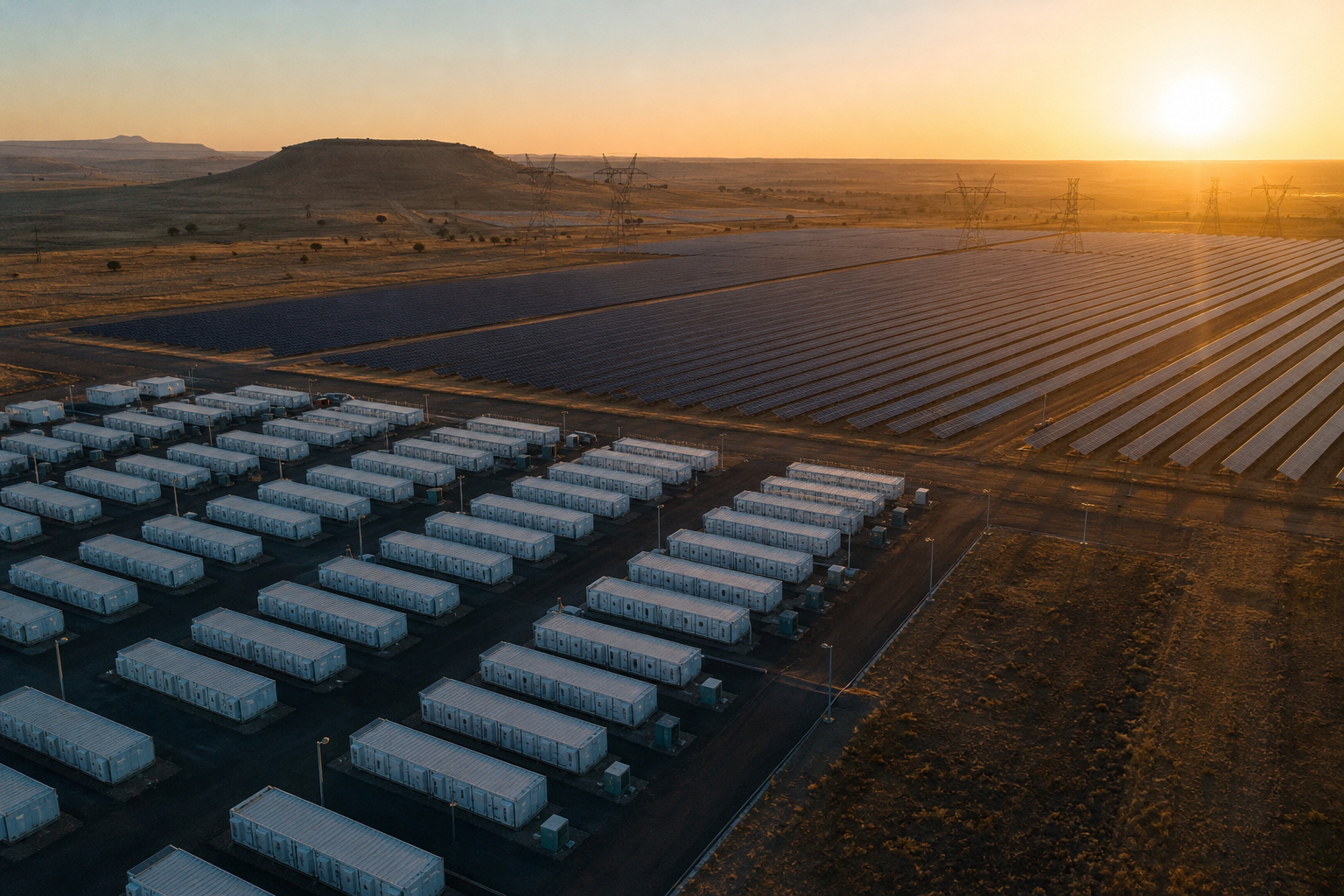
Naos-1 will comprise a 300 MW (435 MWp) solar PV facility coupled with 855 MWh (660 MWh contracted to Sasol and Air Liquide) of lithium-ion battery energy storage, with the wheeled electricity to be purchased at "competitive tariffs" by the two industrial offtakers. The gap between total installed BESS capacity (855 MWh) and contracted BESS capacity (660 MWh) is a critical structural signal: the project sponsor retained a 195 MWh buffer to manage grid balancing, curtailment risk, and future ancillary services revenue — a risk allocation decision that C&I buyers negotiating behind-the-meter BESS displacement ratios must now replicate in their own contract architectures.
Naos-1 is the country's first utility-scale solar PV and BESS project purpose-built for wheeling to private end-users, made possible by an innovative time-of-use contract structure. The PPA is not priced on a flat, daytime-only energy credit. The BESS unlocks evening peak dispatch, aligning generation economics with the TOU periods that drive the largest cost exposure for industrial buyers. Any solar-only long-tenor PPA that does not include BESS-backed evening dispatch is now structurally inferior to the Naos-1 template on a delivered-cost-per-MWh basis.
Envision Energy has been signed to supply the 660 MWh battery energy storage system for the project near Viljoenskroon, with WBHO delivering construction. The site is located near Viljoenskroon in the Free State. Naos-1 is expected to be completed and fully operational in the first half of 2028.
DBSA-Backed Project Finance: What the Domestic Capital Stack Signals for PPA Bankability
Described as the largest privately contracted solar-plus-storage project to reach financial close in South Africa, Naos-1 is backed by local financial institutions including the Development Bank of Southern Africa. The significance of DBSA's participation extends beyond a single deal. All projects confirmed in 2026 were financed by South African banks and local institutions, including the DBSA, highlighting the domestic market's capacity to finance utility-scale projects of several hundred megawatts.
This matters enormously for C&I wheeling counterparty risk allocation. When a project is DBSA-backed, the lender due diligence on wheeling route viability, offtaker credit quality, and BESS dispatch contract mechanics has already been conducted to institutional-grade standards. The DBSA is increasingly focused on renewable-energy financing and transmission infrastructure expansion, particularly as grid limitations continue to constrain new renewable energy generation projects. A DBSA credit presence in a project finance stack is now a signal that the wheeling architecture has been stress-tested — and C&I buyers should treat its absence as a risk flag when evaluating competing solar-plus-BESS supply offers.
Between January and April 2026 alone, eight projects reached financial close, representing 1,932 MW of solar and storage capacity. If advanced pipeline projects materialise, capacity reaching financial close this year could rise to nearly 5,252 MW, surpassing the previous record of 3,562 MW set in 2024. South Africa's domestic capital market is now competing for deals at scale — and that competition is structurally compressing the risk premium embedded in long-tenor PPA tariffs.
Four Contract Repricing Imperatives for Heavy-Process C&I Buyers in Q4 2026
1. PPA Tenor Floor: 25 Years Is the New Anchor Benchmark
Naos-1's 25-year PPA tenor was not achievable without investment-grade anchor offtakers. But the precedent has been set. C&I buyers with strong balance sheets and long-dated process obligations — petrochemical, industrial gas, steel, mining — now have a credible negotiating basis to demand 20-to-25-year tenors from project sponsors who can demonstrate a comparable financing architecture. Any sponsor offering a 10-to-15-year PPA without a compelling BESS dispatch rationale is pricing a structurally inferior product into a market that has moved on.
2. Wheeling Counterparty Risk: The Grid Route Must Be Stress-Tested
NERSA's April 2026 network charge rules have replaced South Africa's obsolete 2012 wheeling methodology, introducing use-of-system charges for both generators and loads and removing the affordability subsidy credit from wheeled energy — changes that raise the wheeling cost floor and force C&I buyers to rebuild every delivered-price PPA model before signing. Naos-1 transmits power from the Free State to Sasol's Secunda operations across a long wheeling corridor. The project is structured as a wheeling project, transmitting power generated in the Free State across Eskom's grid to industrial offtakers elsewhere in the country. Any C&I buyer signing an off-site wheeled PPA in Q4 2026 must confirm that the wheeling route has been formally capacity-confirmed under the updated network charge framework — not assumed.
3. BESS Displacement Ratio: The 660/855 MWh Split Is the New Sizing Template
The 77% contracted-to-installed BESS ratio embedded in Naos-1 (660 MWh contracted against 855 MWh installed) is a deliberate buffer that C&I behind-the-meter buyers must now replicate in their own storage sizing logic. BESS is increasingly strategic — the Market Code's system balancing requirements create an explicit incentive for dispatchable, storage-backed generation, with BESS assets positioned to benefit from time-of-use arbitrage and future ancillary services revenue streams as the market matures. Buyers who contract 100% of installed BESS capacity with no operational buffer are exposed to dispatch shortfalls during peak periods — and that exposure is not priced into most C&I supply agreements currently on the market.
4. Carbon Cost Integration: The R308/tonne Hidden Multiplier
South Africa's Carbon Tax Phase 2, live from 1 January 2026, has raised the headline rate to R308/tonne and introduced Scope 2 electricity emission considerations — creating a compounding hidden cost multiplier for grid-dependent C&I businesses. For heavy-process buyers like petrochemical and industrial gas operators, Scope 2 exposure on grid electricity makes a 25-year wheeled renewable PPA not just an energy cost hedge but a carbon liability hedge. Naos-1's offtaker profile — Sasol and Air Liquide, two of South Africa's largest Scope 1 and Scope 2 emitters — reflects exactly this logic. C&I buyers with material carbon tax exposure should be modelling their PPA economics on a carbon-adjusted delivered cost, not a raw tariff comparison.
The Pipeline Signal: Naos-1 Is Not a One-Off
Naos-1 is the first of several projects SOLA Group is rolling out using battery storage to deliver low-cost, clean energy to South African businesses, with a further 600 MW of hybrid solar and battery projects at a highly mature development stage. The facility is part of SOLA's broader Naos solar project, which includes future Naos-2 and Naos-3 facilities. The structural template — utility-scale solar, deep BESS, long-tenor multi-anchor PPA, DBSA-backed project finance, private wheeling — is now proven and replicable. The window to negotiate as a price-taker in a supply-constrained market is closing fast.
As of May 2026, the National Energy Regulator of South Africa registered over 19.3 GW of new generation facilities, with the vast majority specifically intended for wheeling to private buyers. South Africa's midday solar glut is driving curtailment instructions to over 1,000 per month in 2026 — and private wheeling PPAs have zero regulated compensation for oversupply curtailment. The buyers who lock in long-tenor BESS-backed agreements now, priced against the Naos-1 benchmark, will be insulated from both curtailment risk and tariff compression. The buyers who wait will be negotiating in a market where the best grid slots, the strongest project finance stacks, and the most credible developer counterparties are already committed.
The SolarXgen View: What to Do Before Year-End
Naos-1 has answered the market's most sceptical question: it is not simply a big project — it is the answer to whether utility-scale, dispatchable, privately financed renewable energy can be delivered to private industrial offtakers via wheeling at competitive tariffs, with full project finance. The answer, as of February 2026, is an unambiguous yes.
For C&I heavy-process buyers, the Q4 2026 action list is clear. First, reprice every existing or proposed long-tenor PPA against a 25-year tenor floor, BESS-backed evening dispatch, and DBSA-equivalent lender due diligence as the minimum credibility threshold. Second, rebuild your delivered-cost model using the updated NERSA wheeling charge methodology — the old 2012 framework numbers are no longer valid. Third, integrate carbon tax at R308/tonne into your Scope 2 cost baseline to understand the true economic value of a wheeled renewable supply agreement. And fourth, confirm your wheeling corridor capacity before signing — South Africa's installed solar capacity reached 9.76 GW in 2026 and is projected to grow to 16.88 GW by 2031, placing growing pressure on available transmission headroom.
The Naos-1 template is now the market. Every C&I supply agreement signed without reference to it is being priced against the wrong benchmark.
Sources & References
- Sasol Media Release — SOLA Group reaches Financial Close and begins construction on Naos-1 (9 February 2026)
- IT-Online — SOLA Group starts construction on hybrid solar and battery project (24 February 2026)
- Engineering News — Landmark private solar-battery hybrid project aims to enter into operation in 2028 (27 February 2026)
- ESS News — Envision to supply 660 MWh BESS for South Africa's Naos-1 (30 June 2026)
- Ecofin Agency — South Africa's Largest Private Solar-Plus-Storage Project Reaches Financial Close (2026)
- Ecofin Agency — South Africa on Track for Record Year in Renewable Energy Financing (May 2026)
- Engineering News — DBSA eyes bigger energy sector role (June 2026)
- MyBroadband — South Africa's most powerful private power plant begins construction (February 2026)
- Wikipedia — Naos-1 Hybrid Solar and Battery Project
- SolarXgen Insights — Naos-1 Financial Close: C&I Off-Take Structuring Guide (2026)
- SolarXgen Insights — South Africa's Market Code Goes Live April 2026 (2026)